
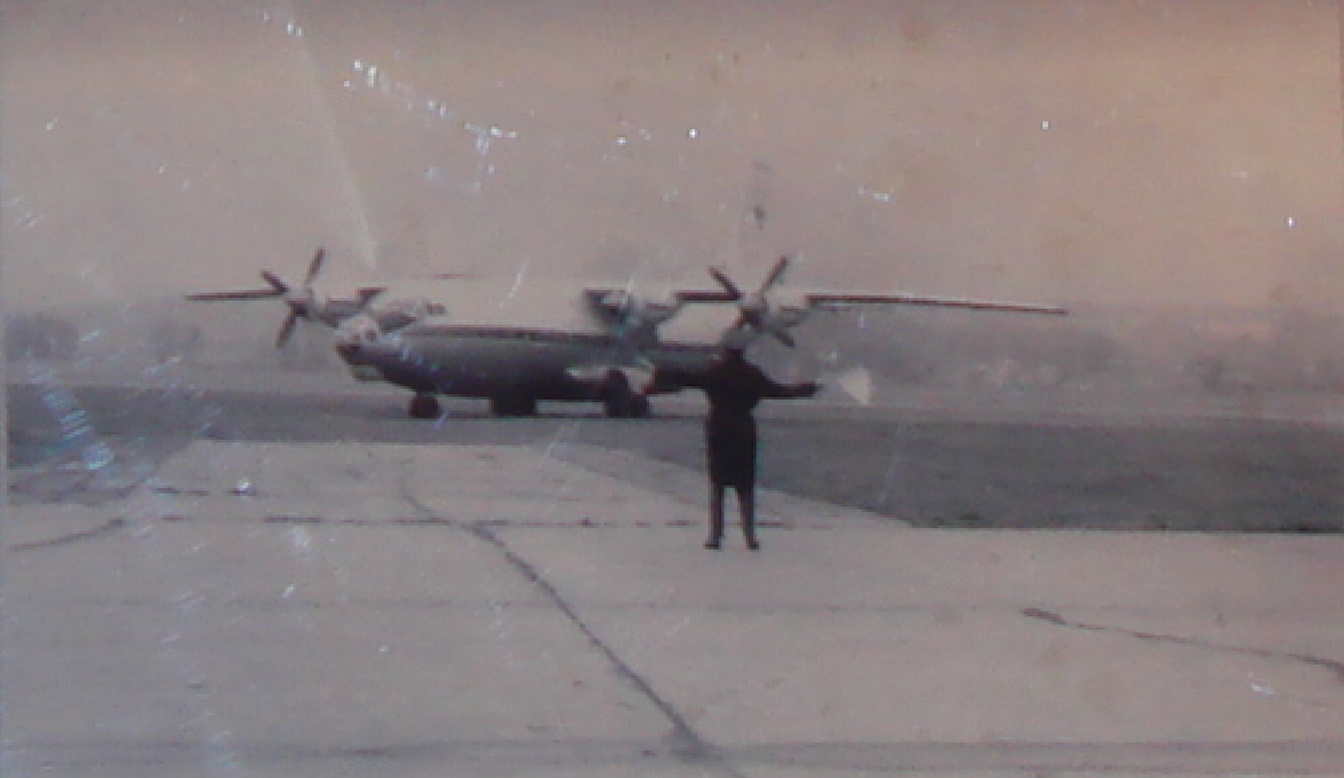
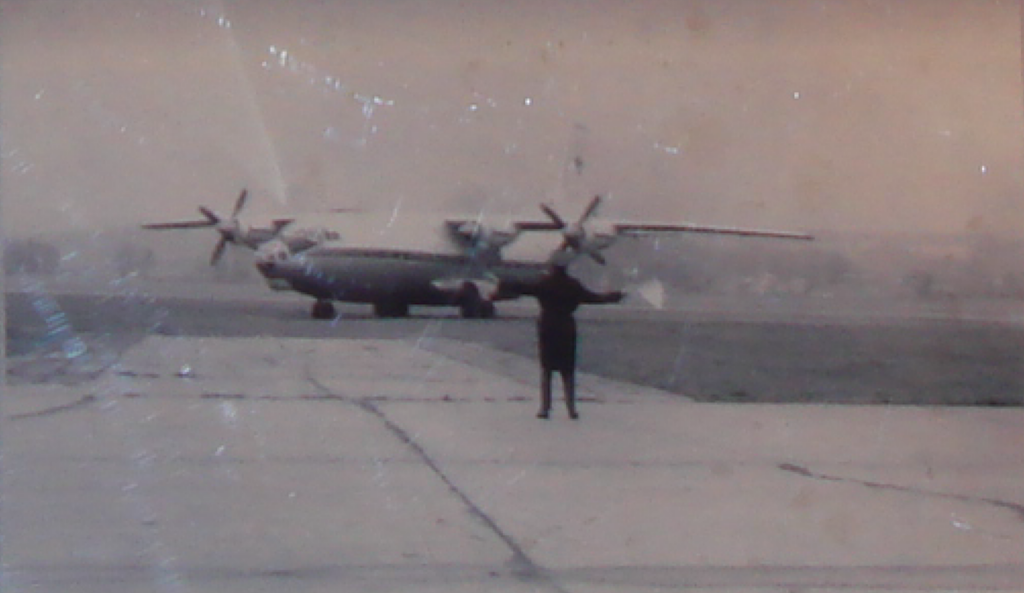
Kraków 2008-12-02
Antonov An-12 transport aircraft in Poland.
202c Tally 1966-09-24
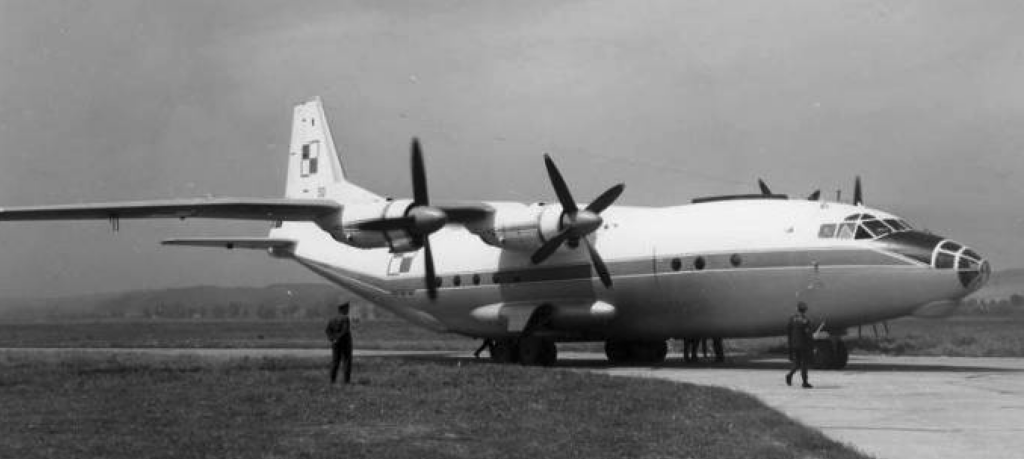
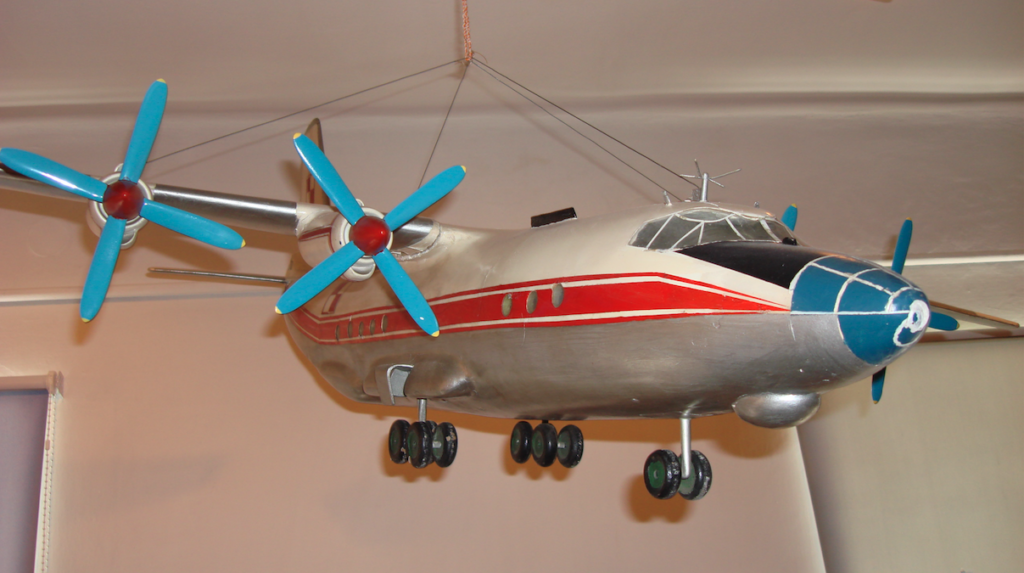
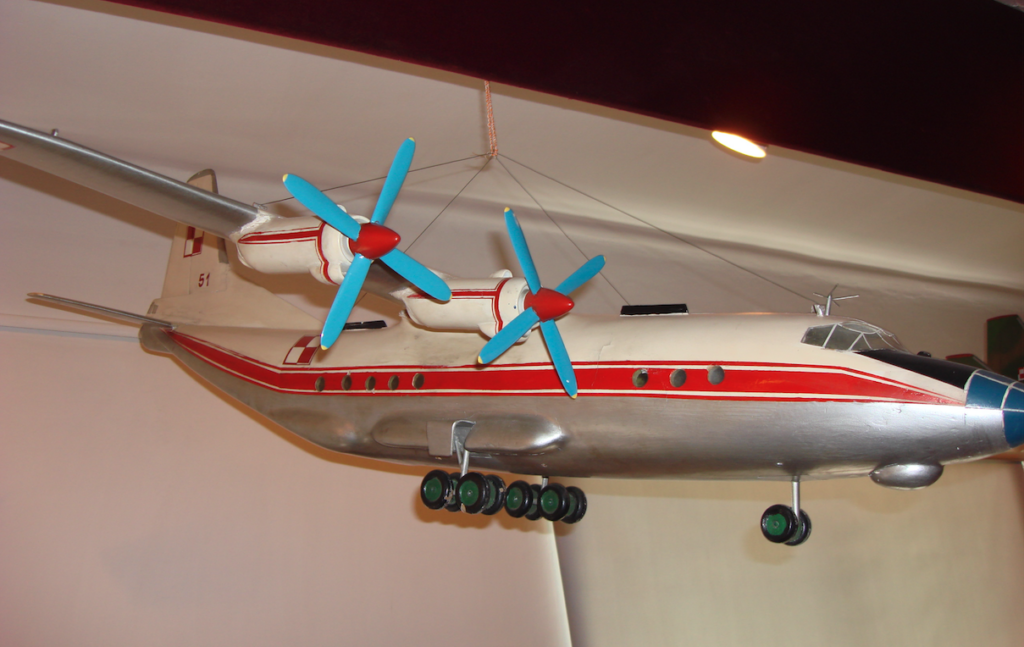
At the turn of 1952 and 1953, a team led by Oleg K. Antonov designed a high-wing aircraft powered by two NK-4 turboprop engines, designated the An-8. The NK-4 engines have an output of 3,754 kW (5,100 hp). Serial production began and lasted until 1955. Most of the aircraft were delivered to the CCCP military aviation.
The An-8 became the forerunner of subsequent versions of transport aircraft. As a result of design development, two aircraft were created in parallel: the An-10 Ukraina passenger aircraft and the An-12 transport aircraft. Both prototypes first flew in 1957. The An-12 made its first flight on December 16, 1957. Aircraft production began in 1958, as it was not difficult to do. The differences between the An-8, An-10, and An-12 are minor. All aircraft were assembled on the same assembly line. According to available information, a total of 1,248 An-8/-10/-12 aircraft were produced. The An-10 was displayed at the Expo-58 world exhibition in Brussels, where it was awarded a gold medal and diploma.
The An-12 was equipped with four turboprop engines and an additional fifth engine (APU) used for loading and unloading landing platforms and providing electrical power for the avionics when the main engines were not operating. The first aircraft were equipped with Kuznetsov NK-4 engines with a reduced power output of 4 x 2,944 kW (4 x 4,000 hp), but with an extended service life. Later aircraft were equipped with Ivchenko AI-20K engines with the same power output of 4 x 2,944 kW but with reduced fuel consumption. The last produced aircraft were equipped with AI-20M engines with 4 x 3,128 kW (4 x 4,250 hp). In the event of a failure of one engine, the An-12 can continue flying at an altitude of 8,000 m, and in the event of the loss of two engines at an altitude of 6,000 m. This is possible thanks to the good aerodynamics of the airframe.
It’s true that the CCCP only designed military aircraft, but the An-12 is a truly military aircraft. It belongs to the offensive weapons system and, as recently as 2008, formed the backbone of the Moscow state’s operational forces. It was a workhorse in the CCCP and continues to be so in the current empire. The An-12’s primary purpose is to transport airborne troops, including their weapons. A secondary mission is to transport platforms with military equipment and parachute them in. This means that cannons, combat vehicles, tanks, and other equipment in crates can be delivered to any region of the world. The final primary mission is the transport of cargo between airports. This list shows that the Soviets were able to deploy entire divisions or other tactical formations using the An-12.
For parachute or airborne landings, the An-12’s cargo hold can accommodate: – 60 paratroopers with equipment. – 105 soldiers with equipment, i.e., the landing force. – 76 wounded, including 60 on stretchers, 16 seated, and 9 crew members. – 2 platforms with a load capacity of 2 x 3,500 kg and 20 soldiers. – 1 platform weighing 3,500 kg and 10 tons of cargo. – 10 tons of cargo to be dropped by parachute.
A parachute drop can be performed in the same way as from smaller and slower aircraft, i.e., with forced parachute deployment. However, it can be performed at airspeeds of 300-400 km/h and at higher altitudes. In such cases, jumps are performed under the influence of a stabilizing parachute, which is designed to slow the jumper’s speed and shorten the time spent in the air. Only then does the main parachute deploy.
Special platforms are used to drop heavier equipment. The aircraft carries two such platforms with equipment attached to them by ropes. The platforms have small wheels (rollers), and after opening the rear doors in mid-air, they are deployed using a conveyor belt or a small parachute. The cargo descends very quickly, ensuring high accuracy. Only then do the main parachutes deploy. Their number and size depend on the weight of the cargo. Just before touchdown, a set of two or three small rocket engines is often used, which, when activated for a fraction of a second, slow the cargo. However, anyone who thinks this is a soft landing would be mistaken. GAZ-69 all-terrain vehicles, ASU-57 self-propelled guns, anti-aircraft guns, and missile launchers can be delivered this way. Heavier equipment is delivered by a landing craft, such as an ASU-85 armored gun. The aircraft can land on a captured airfield occupied by paratroopers. The An-10 Ukraine aircraft is known as the civilian version of the An-12. It can carry 120 passengers or 20,000 kg of cargo. These aircraft were operated by Aeroflot and, after its dissolution, by other smaller commercial companies. These aircraft operated and continue to operate on routes to the Far East and Siberia. These aircraft also supplied overseas scientific and research stations of the CCCP-Russia. They covered enormous distances: Moscow-Tashkent-Dhëli-Rangoon-Jakarta-Sydney-Crayschurch-Mirny in Antarctica.
After the creation of Bangladesh from the former East Pakistan, Soviet An-10/12 aircraft transported thousands of people from India on the Calcutta-Rajpur route. In 1966, An-12 aircraft launched a Moscow-Paris cargo route, and in 1971, a similar Moscow-Berlin route.
Production of the An-8/-10/-12 and its parts was carried out in Irkutsk, Voronezh, and Tashkent. By 1972, 262 An-12B aircraft had been built. In addition to the signatory states of the Warsaw Pact, the aircraft were also used by India, Algeria, Egypt, Indonesia, Iraq, Bangladesh, and others. In December 1971, India used An-12s as bombers in the war against Pakistan. India adapted several An-12s for patrolling the Indian Ocean.
The An-12 and Polish Soldiers.
The first appearance of An-12s in Poland was during the “Baltic” exercises, conducted in October 1962. These exercises took place in Poland’s Western Pomerania. The 19th Airborne Battalion participated in them. It’s worth noting that these maneuvers were related to the Cuban Missile Crisis and the placing of all units under the command of the allied forces of the Warsaw Uprising on combat alert.
Polish soldiers encountered the An-12 in May 1963, when soldiers from the 6th Pomeranian Airborne Division underwent practical training, under the guidance of Soviet instructors, in jumps and cargo drops from An-8 and An-12 aircraft.
In September 1963, exercises codenamed “Quartet” were conducted, as four countries participated. This time, they took place in southern East Germany (German Democratic Republic). The 16th Airborne Battalion participated on the Polish side. These exercises utilized extensive airlift and combined airborne forces to destroy enemy tactical missiles. The Soviet 105th Airborne Regiment of the 7th Airborne Division parachuted into the designated area. Troops and landing platforms, including ASU-57 guns, were deployed. They marched all night and, at dawn, attacked enemy missile sites. During the march, they crossed a bridge that had previously been captured by troops from the 5th East German Parachute Battalion, landing in Mil Mi-4 helicopters.
Landing of the 6th Pomeranian Airborne Division. 1965.
The 6th Pomeranian Airborne Division was formed in June 1957 in Kraków and almost immediately became an elite unit of the Polish Army. This was due to the high level of training of its soldiers and the intended nature of operations, which involved combat operations behind enemy lines. The comprehensive training of the Polish division’s soldiers meant that, from 1962 onward, the division regularly participated in Warsaw exercises organized in Poland, the German Democratic Republic, and Czechoslovakia.
From October 19-24, 1965, an exercise codenamed October Storm was conducted in the GDR (Thuringia). Four countries participated. On the Polish side, the 6th PDPD, this time with its entire force, participated. At that time, the division commander was Brigadier General Edwin Rozłubirski. The exercise was directed by Soviet Army General Pavel Kashevoi, and coordinated by Soviet Marshal Andrei Grechko (at that time commander of the Armed Forces of the Polish Armed Forces and later Minister of Defense of the Central Committee of the Soviet Union). This was the first exercise conducted by two divisions: the 6th PDPD and the Soviet 7th Airborne Division. The exercise involved an offensive-defensive attack, effectively a counterattack, against NATO forces that had invaded East Germany. The attack by Polish forces was intended to separate the main NATO forces from their rear.
The Polish division embarked on 180 (!) An-12 aircraft. After takeoff, an airborne assembly took place, and the entire armada set course for Erfurt. The flight lasted approximately two hours. The landing began on October 21, 1965, at approximately 1:05 PM. 4,130 Polish paratroopers landed near Erfurt Airport. The weather conditions were difficult. Gusty winds and fog. Jumps were made from aircraft flying at 320-360 km/h from an altitude of 800 meters, using D-1 parachutes with a 5-second stabilization period. Some landed in trees or in very wet areas. The airfield was quickly taken over, and soon An-12 aircraft carrying landing troops began landing at 30-second intervals. On board were, among other things, GAZ-69 trucks with mortars or WP-8 rocket launchers, and ASU-85 anti-tank guns.
The following story is connected with the ASU-85 guns. These guns were reportedly borrowed from the Soviet 7th Guards Airborne Division from Kaunas. During the exercises, they were operated by Soviet soldiers in Polish uniforms. The guns bore the checkerboards and insignia of the 6th PDPD. In fact, this equipment remained in Poland. It is also worth noting that, in the spring of 1966, 25 ASU-85 guns were used to form the 35th Self-Propelled Artillery Division (four batteries of six guns each and a commander’s gun). This division was disbanded in December 1979, and some of its guns were donated to Polish museums.
As mentioned, the 6th PDPD carried out the landing with its entire force. Only the 9th Airborne Training Battalion reached Erfurt by rail (commander Lieutenant Colonel Czesław Miszczak) and secured the landing of the An-12 aircraft. The airfield from which the parachute landing team took off was Balice, and the landing team from Powidz Airport. The parachute landing team commander was Brigadier General Edwin Rozłubirski, and the landing team was Lieutenant Colonel Tadeusz Ulaniak. The remaining team was commanded by Lieutenant Colonel Marian Pajor. According to popular opinion, the Poles impressed with their bravado and high skill.
Unfortunately, the landing was not without tragedy. Krzysztof Nadolny of the 10th Airborne Battalion was killed while making his 12th jump. After leaving the aircraft, he failed to release the second stage stabilization and then deployed his reserve parachute, causing it to become entangled with the main parachute stabilizer. Ten other paratroopers suffered serious injuries: two spinal fractures, one head injury, one clavicle fracture, and six lower limb fractures. In such operations, Polish losses were still lower than typically estimated (up to 1% of the total airborne force). A Soviet field trauma hospital prepared 50 beds for Polish soldiers. Following the exercises in Erfurt, a parade was held. The 9th Airborne Training Battalion marched, while the remainder paraded in a circular formation. It should be noted that these events were the subject of a film reportage entitled “From the Clear Sky” by the “Czołówka” Film Studio. Reproductions of this film have served as a reminder of these events for many years. The film is available on YouTube (since 2012).
An-12 aircraft for Poland. 1966.
In September 1966, the first and, as it turned out, only An-12 aircraft were delivered to Poland. On September 24, 1966, the first An-12, No. 6344308, No. 51, landed at Balice Airport, followed five days later (on September 29, 1966), by the second An-12, No. 6344307, No. 50. The aircraft were assigned to the 55th Transport Aviation Regiment. However, in May 1967, due to a major reorganization of the Polish Military Aviation, this regiment was renamed the 13th Transport Aviation Regiment. Interestingly, the name “Ukraine” stuck with this unit. As early as October 1966, these aircraft participated in the Warsaw University exercises in the Silesian Military District, codenamed “Autumn.” In August 1967, they participated in combined maneuvers of CCCP, Polish, and East German military staffs and units at the Borne-Sulinowo training ground. In 1968, they participated in naval exercises at the Ustka training ground. In the fall of 1969, they participated in the Oder-Neisse exercises. One of the airfields where Soviet An-12s were based at that time was the Malbork airfield.
The aggression of the CCCP and Warsaw University states against Czechoslovakia. 1968.
What had been practiced for several years, with the extensive use of An-12 aircraft, intended to be used against NATO forces, was practically used against the people of Czechoslovakia during the invasion in 1968. How did this come about? On January 4, 1968, Alexander Dubcek became First Secretary of the Czechoslovak Party. He wanted to introduce a more humane socialism. He announced the introduction of multi-party politics, the abolition of censorship, and free elections. Economic reforms and the rehabilitation of those repressed by communism were announced. Already on March 23, 1968, at a meeting in Dresden, the communist parties and governments of Czechoslovakia, Bulgaria, the GDR, Poland, Hungary, and the Soviet Union were concerned and used the term counterrevolution. The first to utter the word counterrevolution was Leonid Brezhnev, then First Secretary of the Soviet Party. On March 30, 1968, the Czechoslovak Party plenum elected General Ludwik Svoboda president. The Kremlin grew increasingly nervous. UW (Warsaw Pact) meetings were held. On June 18, On July 2, 1968, the Warsaw Uprising exercises, codenamed “Šumava,” were conducted in Czechoslovakia. Initially, these exercises were intended to involve only the Czechoslovak and Czechoslovakian armies, but pressure from the Kremlin resulted in the inclusion of Polish and Hungarian forces. The exercises were intended to intimidate the Czechoslovak public and serve as a possible preparation for the planned invasion.
In May 1968, the 24th Guards Motorized Rifle Division was relocated to the areas of Cieszyn, Bielsko-Biała, and Pszczyna. One element of the exercise was a maneuver codenamed “Cloudy Summer ’68,” which involved changing troop deployments. The headquarters for the “Šumava” exercise, and later for Operation Danube, was located in Legnica, and its commander was Soviet Marshal Ivan Yakubovsky. The future invasion force was divided into two armies: Army North and Army South. Army North, under the command of Soviet Army General Ivan Pavlov, with headquarters in Legnica, was to enter Czechoslovakia from East Germany and Poland, taking control of northern and western Czechoslovakia, particularly the regions of Karlovy Vary, Pilsen, and České Budějovice. Preparations were made for the operation; The Soviet 1st Guards Tank Army from the GDR, the Soviet 11th Guards Tank Army from the GDR, and the 2nd Polish Army, composed of units of the Silesian Military District, under the command of Brigadier General Florian Siwicki. The Southern Army, commanded by Colonel General Konstantin Pravalov with headquarters in Matyasfold near Budapest, was to enter from Hungary, the GDR, and Transcarpathian Ukraine, occupying Slovakia and south-central Bohemia including Prague. It included the Soviet 20th Guards Army from the GDR, the Soviet 38th Guards Army from the CCCP, the Soviet 36th Air Army from Hungary, and the Hungarian 8th Motorized Rifle Division from Hungary. The most mobile element was the landing force, composed of: The Soviet 7th Guards Airborne Division from Kaunas to capture Prague and the Soviet 103rd Guards Airborne Division from Vitebsk to capture Brno. The 7th Panzer Division from Dresden and the 11th Motorized Rifle Division from Halle were detached from the GDR forces for the invasion. They were placed on combat alert but did not take part in the invasion for political reasons. Some high-ranking officers serving on the staff in Hungary and a group to secure communications from the 2nd Signal Regiment physically participated in the invasion. On July 14, 1968, five communist parties of the Warsaw Uprising countries addressed a letter to the party and government of Czechoslovakia. A clear conflict arose between the Kremlin and Prague. On July 29, 1968, a bilateral meeting took place between Soviet and Czechoslovak politicians. On August 3, 1968, a six-party party meeting took place in Bratislava, which turned out to be the last before the invasion.
Operation Danube. August 20/21, 1968.
The goal of the military invasion of Czechoslovakia was for the Kremlin to seize key state institutions, including the press, radio, and television, and to kidnap the leaders of the Prague Spring. The decision to invade was made in the Kremlin during a meeting of the CCCP leadership from August 14-17, 1968, and on the day of the attack, the Czechoslovak Minister of National Defense issued an order to offer no resistance to the invaders. The main invasion force consisted of CCCP soldiers. Detached units from Poland, Hungary, and probably Bulgaria participated in the invasion. Most Polish Army soldiers were unaware of the planned invasion. The attack involved 750,000 soldiers, 630 tanks, and 800 aircraft, primarily An-12 transport aircraft. Poland sent 26,000 soldiers and equipment. Approximately 200 people died. This invasion is considered the largest military operation in Europe after World War II.
One of the episodes.
During the communist era, August 23rd was aviation day in Poland. As every year, many cities prepared for the celebration. In mid-August 1968, a dozen Lim aircraft were gathered at Balice Airport to celebrate the upcoming event at Czyżyny Airport. The pilots of these aircraft practiced orientation and formation planning. However, on August 20th, 1968, the planned flights were canceled, despite the typical aviation weather. The pilots and their aircraft waited. Early in the afternoon, a four-engine transport plane appeared near Balice and, after circling, descended for a landing. It taxied to the end of the runway (RWY) and positioned itself on the grass. There was no doubt that it was a Soviet An-12. Gray with large red stars on the vertical tail and a large two-digit number on the fuselage. A window was opened in the cockpit, and an officer leaned out, holding a microphone. He was looking toward the glide path. The hum of the engines of the next An-12 aircraft was growing louder. One by one, the planes landed and lined up neatly on the grass in the northern part of the airfield. As it turned out, the Soviets hadn’t established any communication with the guidance center in Balice. They were making their own arrangements. In total, about 25 planes landed at Balice Airport. The engines were shut down, the propellers stopped, but the charging system remained open. The noise was still coming from the planes. The fifth engines (APU) were running, providing power, primarily for the communications systems. Only the planes’ side doors were open, the ladders were extended, and a few soldiers were inspecting their planes. The planes’ tires were covered in mud, indicating they had taken off from an airfield with a dirt runway. Antennas for long-range communications were erected. They requested that the planes be refueled, which, due to the number of planes, took several hours. The Soviet soldiers were very relaxed. They joked and laughed. They smoked cigarettes, even while refueling. Some sat in the wings. They didn’t engage in arguments and kept prying eyes away. Besides, getting to their planes required crossing the runway. Practically, only fuel tanker trucks approached their planes. Their departure took place after 10:00 PM. Where? Over Czechoslovakia.
The Polish Army’s Participation.
For Poland, the invasion of Czechoslovakia began on August 20, 1968, at 11:40 PM, when General Florian Siwicki received an order from the Soviets to cross the border into Czechoslovakia. At 11:50 PM, nine commandos from the Independent Assault Battalion captured the guardhouse in Lubawka without firing a shot. They were the first to enter the territory of the independent state. Polish tanks and armored personnel carriers moved towards Hradec Králové. Their tactical numbers were invisible, and white stripes were painted on their hulls with whitewash.
Further Consequences of the Attack on Czechoslovakia.
On August 22, 1968, an illegal KSČ party congress was held at the Kremlin’s behest. Between August 23 and 26, 1968, the Kremlin forced Czechoslovak representatives to “normalize” in exchange for an end to the occupation. Ultimately, pro-Moscow forces succeeded in removing Alexander Dubček from power and sending him as ambassador to Turkey in 1969. Purges within the party and military ensued.
An-12 Operations in Poland.
In November and December 1973, the aircraft began transporting soldiers from the first rotation of the Polish Military Special Unit of the UN Emergency Force in the Middle East. The An-12 made its first flight on this mission on November 13, 1973, transporting a logistics group consisting of 10 officers, three non-commissioned officers (NCO) drivers, and three GAZ-69 vehicles. From November 16, 1973, the An-12s began transporting Polish soldiers, primarily from the 6th PDPD, to Cairo. They transported equipment, food, firewood, Star 660 and GAZ-69 vehicles, and other supplies. From November 13, 1973, to December 12, 1973, they maintained a near-regular air bridge between Krakow and Cairo. The flights were non-stop, flying the Kraków-Budapest-Belgrade-Skopje-Thessaloniki-Crete-Cairo route. At an average altitude of 7,600 m and a speed of 560 km/h, the route could be completed in 5 hours and 20 minutes.
For some time (in 1967), An-12 aircraft also provided services to the national economy. These flights were commissioned by LOT Polish Airlines, as civilian charter flights. At that time, the aircraft were assigned civilian registrations SP-LZA, SP-LZB, and reportedly SP-LZC. The checkerboard patterns were painted over the fuselages, wings, and vertical tail. Registrations were applied, and the LOT Polish Airlines logo and a red-and-white flag were painted on the vertical tail. Heavy loads were transported this way to Astrakhan, Hanoi, Cairo, London, Benghazi, Rome, Venice, Tokyo, and others.
It is known that the An-12 NB 50 aircraft flew as SP-LZA with LOT Polish Airlines in June and July 1967, and then from August 1976 until its crash on May 13, 1977.
Polish An-12 aircraft crash. 1977.
On May 13, 1977, An-12 SP-LZA nb 50, tail number 6344307, was operating a flight from Rzeszów to Beirut (the capital of Lebanon). While approaching Beirut Airport, located in the Khalden district, it crashed at approximately 8:45 a.m. local time. Beirut Airport is the only civilian airport in Lebanon. The entire crew, nine people, died. The aircraft was carrying a cargo of strawberries to Lebanon. The instruction from Beirut ground control to follow the designated glide path was repeated twice for linguistic reasons. Contact with the aircraft was soon lost. The aircraft struck a mountainside at an altitude of 700 meters, 8 km from the airport. The town of Aramoussieh.
Why? The case remains unsolved to this day, and its details are hidden. Everything is secret because of confidentiality. Of course, one can accept the thesis of crew error and a mountain crash. At that time, in our circles, everyone kept repeating that the plane had been shot down. It’s important to remember that from 1975 to 1990, a civil war raged in Lebanon, in which Syria and Israel were also involved. The second aspect is the issue of the cargo being transported. Rumors spread that the plane was carrying weapons. If so, we have become involved in an insoluble conflict from which our nation gained nothing but tears for our loved ones. Will we ever learn the whole truth, or will we continue to wallow in speculation and circumstantial evidence? I fear that the lack of decommunization and vetting has strengthened the shadows of the Polish People’s Republic, and various commercial media are preying on and feeding the public with sensationalism.
Crew; Captain (first pilot) Lieutenant Colonel Pilot Tadeusz Florek, Lieutenant Colonel Pilot Henryk Bajer, Lieutenant Colonel Navigator Jan Kowalik, Lieutenant Colonel Jerzy Grzywalski, Major Adam Rybak, Captain Janusz Lech, Warrant Officer Kazimierz Krupa, NN, NN. Honor to their memory!
The fate of the An-12 SP-LZB.
During the 1980s, the sole remaining An-12 in Polish Aviation served exclusively as an aircraft in the service of LOT Polish Airlines. At the end of the 1980s, the new management of LOT Polish Airlines decided to dispose of uneconomical Soviet-made aircraft. The An-12 SP-LZB was destined to suffer the same fate. In 1993, its sale to a Bulgarian company operating several An-12s was finalized. Our aircraft, as LZ-SFS, began service in Bulgaria.
An-8/-10/-12 Versions:
Aircraft: – An-8 – version powered by two turboprop engines. – An-10 – transport/passenger version powered by four turboprop engines. – An-12 – basic landing aircraft. – An-12 A – received AI-20 A engines. Fuel tanks were enlarged. Standard lifting capacity increased to 20,000 kg thanks to the reinforced cargo hold floor. – An-12 B – fuel tanks were enlarged again to 18,000 liters. Modified AI-20 M engines were used. A more powerful winch was installed. – An-12 BP – this is the An-12 B for naval aviation. A rescue boat was added. – An-12 BPŁ – this is the An-12 BP adapted for operating in polar regions using a fixed undercarriage with skids. – An-12 T – specialized version for transporting rocket fuel. – An-12 BM – specialized version for satellite communications tests. – An-12 PS – search and rescue version equipped with a small rescue craft. – An-12 PP/PPS – reconnaissance and warfare versions. – An-12 – flying command post. – An-12 BK – modernized An-12 B. – Y-8 – An-12 copied in China (without license rights). Approximately 650 units were built between 1974 and 2006.
Antonov An-12 Design.
The Antonov An-12 is a medium (and in Poland, heavy) transport aircraft, with a medium range. Its Western counterpart is the C-130 Hercules. The An-12 is fully adapted to military needs. It is used for transporting and landing troops and military equipment. The standard crew consists of five crew members: the first pilot (ship’s captain) and the second pilot. Between them sits a mechanic (flight engineer) in a folding seat. The navigator sits in the glass-enclosed nose of the fuselage. Behind the first pilot is the radio operator (communications equipment operator). The crew may also include a gunner, a loader, and a special equipment technician.
The An-12 is a cantilever, four-engine, high-wing monoplane. Its all-metal structure. Aerodynamics are one of the aircraft’s greatest strengths.
The twin-spar wing consists of five sections. The center wing is attached to the fuselage. Intermediate sections attached to the center wing with the engine nacelles. Outer sections. The slotted ailerons have a weighting tab and a trim tab. The ailerons are assisted by spoilers located on the upper wing surface, forward of the ailerons. These spoilers are mechanically connected to the ailerons. When the ailerons are deflected by up to 3 degrees, the spoilers are deflected.
The forward fuselage houses the crew cabin. Behind the crew cabin, there is a compartment for 14 people. This compartment can accommodate a squadron of parachutists for high-altitude landings, meaning they don’t have to deploy their parachutes when exiting the aircraft. Landing is accomplished through a side door on the left side of the fuselage. This compartment, along with the crew cabin, allows for such airtight conditions that oxygen masks are not required up to an altitude of 10,000 m. The central fuselage contains the main cargo hold, measuring 13.5 x 3.5 x 2.6 m, with a capacity of 97.2 cubic meters. The rear door measures 7.70 x 2.95 m. This door consists of three sections, all opening inward. An additional element is a ladder extending from the hatch, used for loading and unloading cargo on the ground. In flight, these doors are opened by the navigator using an electro-hydraulic device. A ceiling-mounted crane with a winch and a conveyor belt are used for loading and unloading. Folding seats are located along the sides of the cargo hold and in the center, providing a total of four rows. This arrangement of the benches allows parachutists to land in two rows. The cargo hold is ventilated and heated and is equipped with an oxygen system for connecting masks. It is used from an altitude of 4,000 meters. The fuselage is equipped with 10 windows on each side. Additionally, the fuselage has two emergency exits: forward and upper. The tail section houses a gunner’s station in the form of a tail turret with two NR-23 cannons. In An-10 aircraft, a toilet is located in this area. Polish An-12s were stripped of their gunnery during their first years of service.
Classic horizontal tailplane, divided into rudder and stabilizer. Each rudder is equipped with a trim tab. The vertical stabilizer is what we today call a strip stabilizer. It consists of a classic vertical stabilizer and a base, the leading edge of which has a very large angle of attack. The leading edges of the stabilizer are electrically de-iced. The landing gear is a three-leg, retractable in-flight landing gear. The nose landing gear is a single-leg, two-wheel, steerable landing gear. The main landing gear is also a single-leg, with four-wheel bogies. It retracts into gondolas located near the fuselage. Hydraulic disc brakes are used. Oil-gas shock absorbers are used.
The An-12 aircraft is powered by four AI-20K turboprop engines, each with a power output of 4 x 3,128 kW (4 x 4,250 hp) at 12,350 rpm. Cruise power is 4 x 1,654 kW (4 x 2,250 hp). The engine comprises a 10-stage compressor, an annular combustion chamber, and a 3-stage turbine. The engines drive metal, left-hand-rotating, four-blade, self-adjusting AW-68I (AW-681) propellers with a diameter of 4.5 m. The propellers can be feathered and reversed. The dry engine weight is 1,240 kg. The engines are designed for 12,000 operating hours. The period between overhauls is 4,000 operating hours. Cruising kerosene consumption is 2,400 liters per flight hour. The engines are started electric using a TG-16 turbogenerator or ground-based equipment. Fuel is stored in 22 tanks located in the wings. In the airborne version, the aircraft carries 18,000 liters. The An-10 version carries 13,900 liters. Fuel is stored in the intermediate sections of the wings and is housed in rubber-lined tanks. The fuel located in the outer sections of the wings has integral tanks and is emptied first. An additional APU engine is located in the main landing gear nacelle, on the left side. Its tasks are as follows: It drives the generators used to start the main engines. It provides electrical power when the main engines are shut down. It is used to start the floor conveyor and overhead crane. It allows cargo to be loaded and unloaded, including in the air.
Equipment and installations. Hydraulic system. Consists of two systems: a main system, with a pressure of 21.0 MPa, and an emergency system, with a pressure of 15.0 MPa. The main system retracts and extends the landing gear, controls the nose gear, applies braking force to the main landing gear wheels, and drives the windshield wipers. The emergency system applies braking force to the main landing gear wheels, adjusts the propellers, and charges the hydraulic accumulator chambers. AMG-10 oil is used. Air conditioning and ventilation system. – Fire protection system. – Anti-icing system. – Electrical system. An-12 radio and navigation equipment. Considering the time in which this aircraft was developed, the radio (communications) and navigation equipment is relatively extensive. It enables flights without a line of sight to the ground. AP-6A automatic pilot. Put navigation and control device, Emblema weather radar. SSR-1600 transponder, DISS-013 navigation radar, SD-67 radio rangefinder. Two Łandyn 20 VHF radios, one R-802W radio, two ARK-11 radio compasses, two Kurs MP-2 navigation sets, an RW-UM radio altimeter, and an SPU-7 on-board telephone. Two signaling electro-flashes were located in the rear right-hand side of the fuselage, activated from the pilot’s cockpit.
An-12 Armament. The typical military version was equipped with a rear gunnery station located in the tail turret. Two NR-23 23 mm cannons were mounted there. Polish An-12s also had these gunnery stations. However, these cannons were quickly removed.
Antonov An-12 T-T data. 1966:
Span 38.00 m. Length 33.10 m. Height 10.58 m. Wing area 121.70 m². Empty weight 28,000 kg. Gross weight 54,000–55,100 kg. Maximum weight 61,000 kg. Payload weight 20,000 kg. Fuel 18,000 liters. Maximum speed 600–777 km/h. Climb rate 10 m/s. Cruising speed 550–670 km/h. Landing speed 190–210 km/h. Maximum range 4,090–5,700 km. Range with payload 3,400–3,600 km. Maximum ceiling: 10,100 m. Takeoff run, ground run: 700-850 / 500-860 m. Engine type: AI-20 K, Power: 4 x 3,126 kW, 4 x 4,250 hp. Crew: 5-8 personnel.
List of An-12s used in Poland.
1 Antonov An-12, no. 6344307, nb 50. Delivered on September 29, 1966. In June-July 1967, used as LOT SP-LZA aircraft. Also used as LOT aircraft from August 1976 until the crash on May 13, 1977.
2 Antonov An-12, no. 6344308, nb 51. Delivered on September 24, 1966. Used as LOT SP-LZB aircraft during: June-July 1967, then May 1968 to 7 July 1972, then from October 1972 to July 1993. In July 1993, with a complete set of spare parts, it was sold to Bulgaria to Air Sofia where it flew as LZ-SFS.
Written by Karol Placha Hetman