
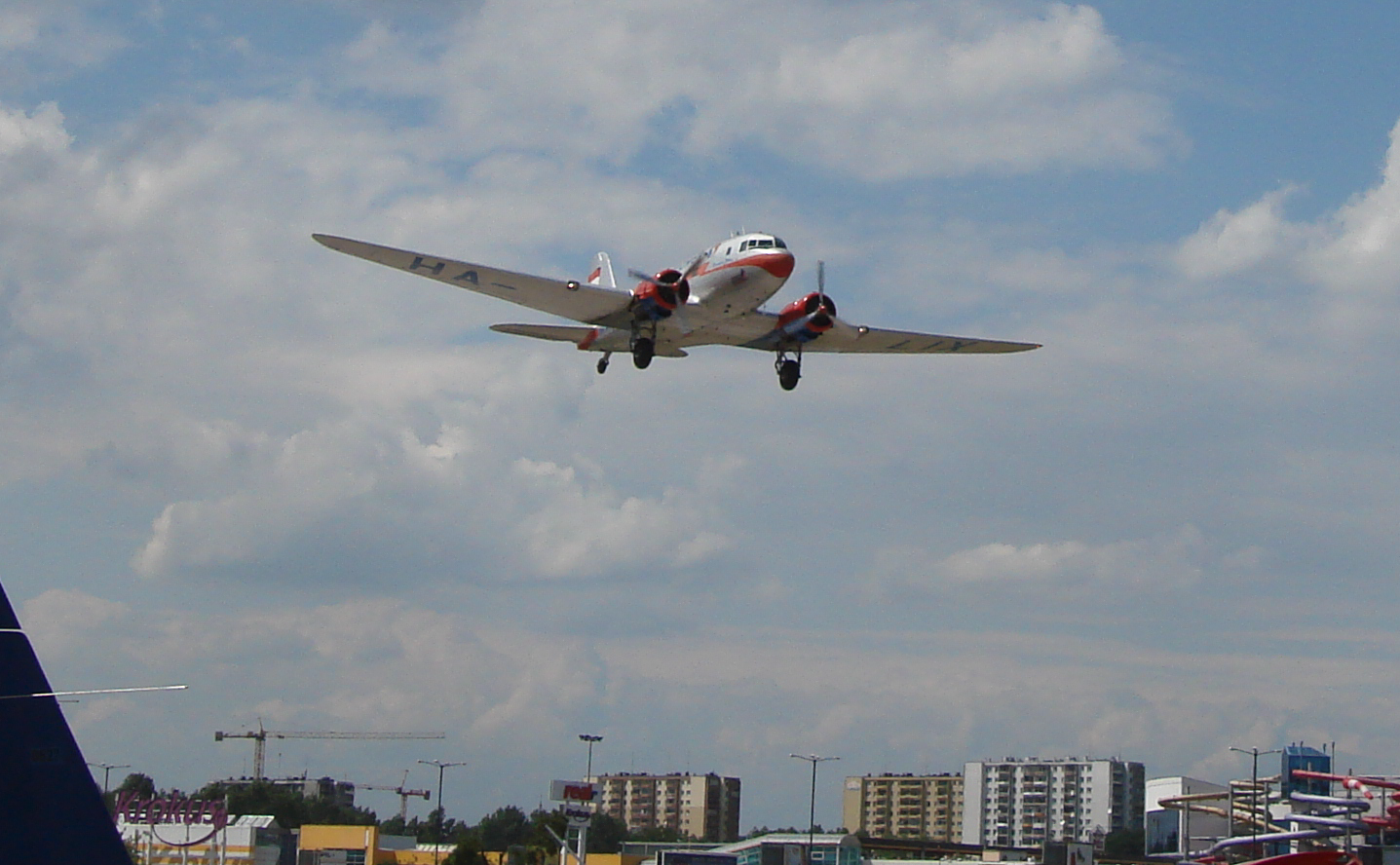
Kraków 2008-10-16
History. 016b Section April 1945.
The Lisunow Li-2 is a transport aircraft modeled after the American Douglas DC-3. Both the Li-2 and DC-3 aircraft were used in Poland after World War II. The primary users were the Polish Army and LOT Polish Airlines. Officially, the first Lisunow Li-2 aircraft were accepted into service with the Polish Army in April 1945.
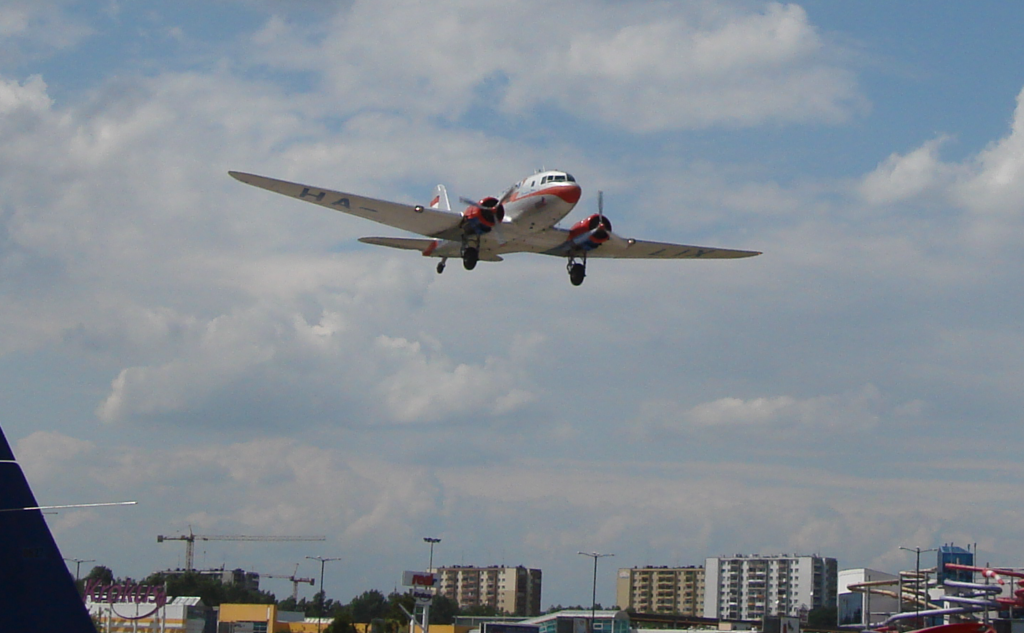
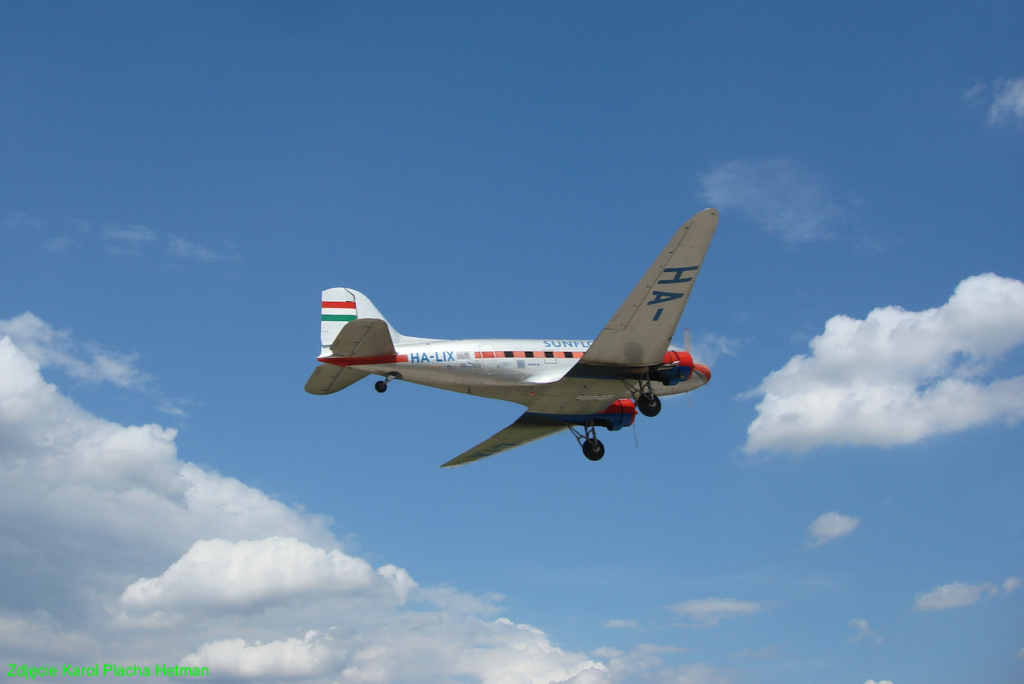
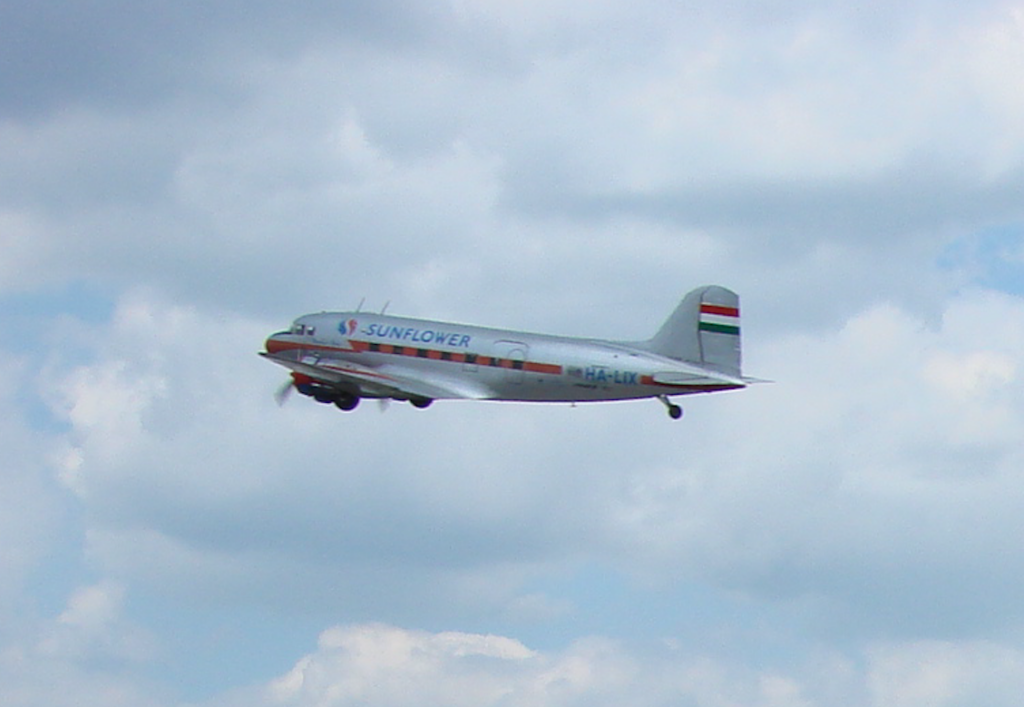
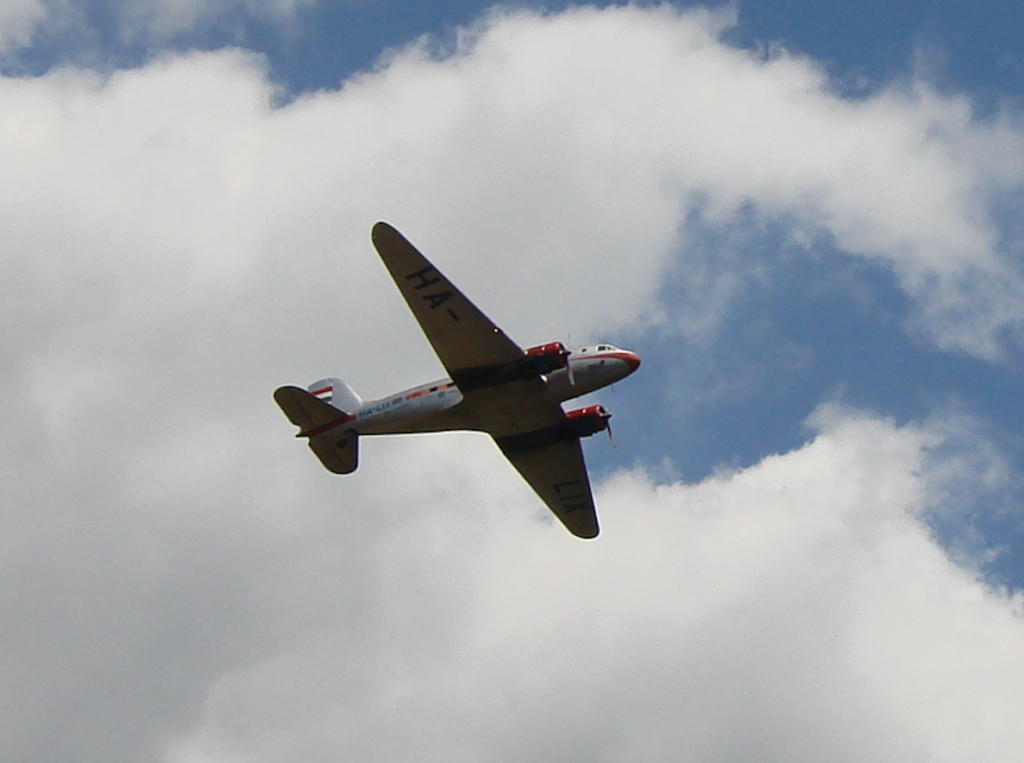
The History of the Lisunov Li-2.
In 1936, a Soviet delegation traveled to the United States to purchase a license for a passenger aircraft that would become the primary aircraft for Aeroflot. At that time, Aeroflot was operating aging passenger aircraft converted from bombers. The Soviets chose the Douglas DC-2, which made its first flight in 1934. However, in December 1935, an enlarged version of this aircraft, designated the DC-3, first flew in the United States. Negotiations were held at Douglas’s main factory in Santa Monica. The talks were finalized in 1937, with the signing of an agreement to purchase production rights and 20 production DC-3s, plus two completely disassembled examples.
The aircraft were delivered to CCCP by sea, partially disassembled. They served as models for mass production, the conversion of imperial measurements to metric measurements, the adaptation of technology to those used at CCCP, and for training purposes for pilots and mechanics.
To avoid any doubt, it should be noted that the Americans licensed the DC-3 passenger aircraft to the Soviets. The aircraft was based on the Douglas C-47 Dakota military transport aircraft, of which the US Army operated approximately 10,000 during World War II, with a total of approximately 13,000 aircraft built. To this day (2008), more than a dozen DC-3s and derivatives remain in service.
Work at CCCP was not easy, as the technical documentation had to be prepared practically from scratch, converting imperial measurements to metric ones. Replacements for equipment parts had to be sought. As many as 1,293 design and technological changes were introduced.
At this point, an explanation is also needed regarding the powerplant. The DC-3 (C-47) aircraft was powered by 14-cylinder, twin-radial, air-cooled Pratt-Whitney Twin Wasp R-1830-92 piston engines, with a takeoff power of 2 x 883 kW (2 x 1,200 hp). The power of these engines ensured a virtually uninterrupted takeoff in the event of an engine failure. The Li-2, however, was equipped with smaller engines, significantly compromising safety. The aircraft used license-built Wright Cyclone R-1820 engines, air-cooled, 9-cylinder single-radius engines, producing 2 x 736 kW (2 x 1,000 hp), initially designated M-1820 by the CCCP, and later M-62/ASh-621R. The Li-2’s propellers were metal, 3-blade, AW-7N-161 type, with a diameter of 3.5 m. The DC-3 aircraft used Hamilton-Standard propellers, also 3.5 m in diameter.
It was not until mid-1938 that preparations for mass production began. Factory No. 84, located in Khimki near Moscow, was selected as the production facility. For this reason, the aircraft received the designation PS-84 (PS pasazhyrskiy samoliet, factory number 84). To give you a heads-up, the Li-2 name was not assigned until 1942, and was associated with Boris Pavlovich Lisunov. Lisunov was the chief designer and led the work on adapting the Douglas DC-3 to Soviet industrial capabilities. Unfortunately, in 1946, Lisunov died, leaving the Li-2 as his only design.
The first Soviet PS-84 (DC-3) aircraft were built in 1939, and by June 1941, only 72 had been built. The aircraft were sold to Aeroflot and used for wartime needs. Military production of the Li-2/PS-84 continued until 1946, with approximately 3,000 units produced. After the war, further production continued primarily for civilian use and export until 1952, totaling 4,863 units. The basic version of the PS-84 / Li-2 carried 3 crew members and 26 passengers.
Li-2 for Poland. 1945.
Polish pilots encountered Douglas DC-3 (C-47) aircraft during World War II in the Polish Armed Forces in Great Britain.
After World War II, the Polish Military Aviation operated 17 Li-2T aircraft. The first aircraft were delivered to the Polish People’s Army in April 1945. By the end of 1945, six aircraft were in service. In 1960, 17 aircraft were in service, and in 1970, 12. For the last three years, three more aircraft were in service, but they were written off in 1974, effectively ending their service after 19 years.
During the 1960s, the Li-2 was operated primarily by the 13th Transport Aviation Regiment, 1st Squadron, supporting parachutists, among other roles. In addition to strictly military missions, charter flights, humanitarian aid flights, and flights for the National Bank of Poland were also performed.
Li-2 and DC-3 at LOT Polish Airlines.
In 1946, the reactivated LOT Polish Airlines acquired 10 Li-2 aircraft from the military. These aircraft launched the first post-war domestic route, Warsaw-Gdańsk.
Also in 1946, nine DC-3 aircraft were purchased and began operating on international routes. They were registered SP-LKA, SP-LKB, SP-LKC, SP-LKD, SP-LKE, SP-LKF, SP-LKG, SP-LKH, and SP-LKI. These aircraft were purchased from military surplus, in the C-47A version. The passenger cabin featured only metal benches. The cabin was modernized and 21 seats were installed, in a 2+1 configuration across seven rows. In 1957, the interior was further modified, installing 24 seats. The last LOT DC-3 retired in 1959 and was sold to Iran.
Admittedly, accurately determining the number of aircraft in service in Poland, both in the military and with LOT Polish Airlines, is very difficult. Some aircraft operated by LOT Polish Airlines wore civilian colors, but were still in service with the military. According to available information, LOT Polish Airlines operated 20 Li-2 aircraft in 1946, 29 in 1947, 39 in 1953, and 40 in 1955. Li-2 aircraft operated by LOT Polish Airlines until 1967. According to other data, until 1969. The Li-2 was undoubtedly the most frequently operated aircraft by LOT Polish Airlines in the 20th century.
A DC-3/Li-2 aircraft, registration SP-LKE “Ewa,” was equipped with special equipment in the early 1960s. This equipment allowed for airborne monitoring of ground-based VOR and ILS equipment. The aircraft was owned by the Air Traffic and Communication Airports Authority (ZRLiLK). It was painted red and white to ensure its visibility from the ground. It served its purpose from July 1967 until November 10, 1970, when it was replaced by an Il-14 SP-LNB, popularly known as “Parrot.” The DC-3/Li-2 SP-LKE aircraft was transferred to the Czyżyny Museum in June 1974. However, a few years later, it was set on fire by young vandals and almost completely destroyed.
At that time, the Polish Aviation Museum also received the Li-2 transport aircraft, No. 39 18436204, decommissioned by the 13th Transport Aviation Regiment (JW. 1616) in Balice. Both aircraft were parked in front of the museum hangar. This aircraft, too, was destroyed by vandals. Both aircraft were scrapped.
After reaching the end of their service, the Li-2 aircraft became major attractions in several Polish cities. One of the aircraft was moved to Lublin’s People’s Park, where a cafeteria/buffet was set up. For many residents of Lublin and the surrounding area, this was the first opportunity to see an aircraft up close, and even see what the aircraft looked like inside.
Residents of Wieruszów also received a similar attraction. Compared to others, this aircraft is unusual because it remains at the “airport” in Wieruszów to this day (2019). “Airport,” as the residents have dubbed the park, even though there never was an airport there. The aircraft was brought to Wieruszów around 1968. The aircraft also housed a cafeteria/buffet, which was closed down after a few years. Fortunately, the aircraft was not removed. Moreover, in 2016, the aircraft was thoroughly inspected by an aircraft mechanic to ensure that the aircraft wouldn’t break apart or a wing would fall off, posing a hazard to those nearby. It turned out that, with the exception of the non-original floor, everything was in good condition, and the plane could still be enjoyed by the residents. Some residents were so excited that they thought the plane was being inspected by a mechanic, hoping it would return to flying. Unfortunately, this dream was not realized. The plane was repainted.
The Last Polish Li-2.
The last flying Li-2 T, no. 18439102 nb 027 (05), former SP-LDA, landed at the home airfield of the 13th Transport Aviation Regiment in Balice in May 1974. It was placed in the Wolski Forest, opposite the entrance to the zoo, and was converted into a café. It was practically a buffet. However, this aircraft, too, failed to survive vandalism. After several years, it was transported to Czyżyny. It was assembled with engines and other equipment from two other destroyed DC-3s / Li-2s, no. 23442002 registration SP-LKE and Li-2 no. 18436204. This aircraft remains one of the most valuable exhibits in the Krakow museum.
Li-2 versions.
Li-2 B – the bomber aircraft. Developed in 1942, it carried a total bomb load of 1,500 kg. It was also armed with one fixed (fixed) forward-firing machine gun and two movable 7.62 mm machine guns.
Li-2 F – the photogrammetric aircraft that took photographs for cartography and economic purposes. Developed in 1945, a small number were built.
Li-2 G – the transport and landing aircraft. Developed in 1942, it carried 26 parachute jumpers or 2,800 kg of cargo. This version was also used to tow transport and landing gliders. It towed one or two gliders.
Li-2 GP – the passenger and cargo (combi) version that could carry 10 passengers and 1,200 kg of cargo simultaneously. Also developed in 1942.
Li-2 P – the passenger aircraft built in the largest number. It carried 28 passengers. This version was used by LOT Polish Airlines.
Li-2 S – the version of the Li-2 G with extended range. Designed for dropping sabotage groups deep behind enemy lines. Developed in 1943.
Li-2 T – the typical transport version. Developed in 1942. In service with the Polish Air Force from April 1945, it was also used as an airborne assault aircraft.
Li-2 W – the weather reconnaissance aircraft, capable of flying at altitudes up to 8,000 m. It was equipped with M-621R engines with RK-19 turbine compressors. The crew used masks during high-altitude flights. The aircraft was developed in 1945.
Written by Karol Placha Hetman