
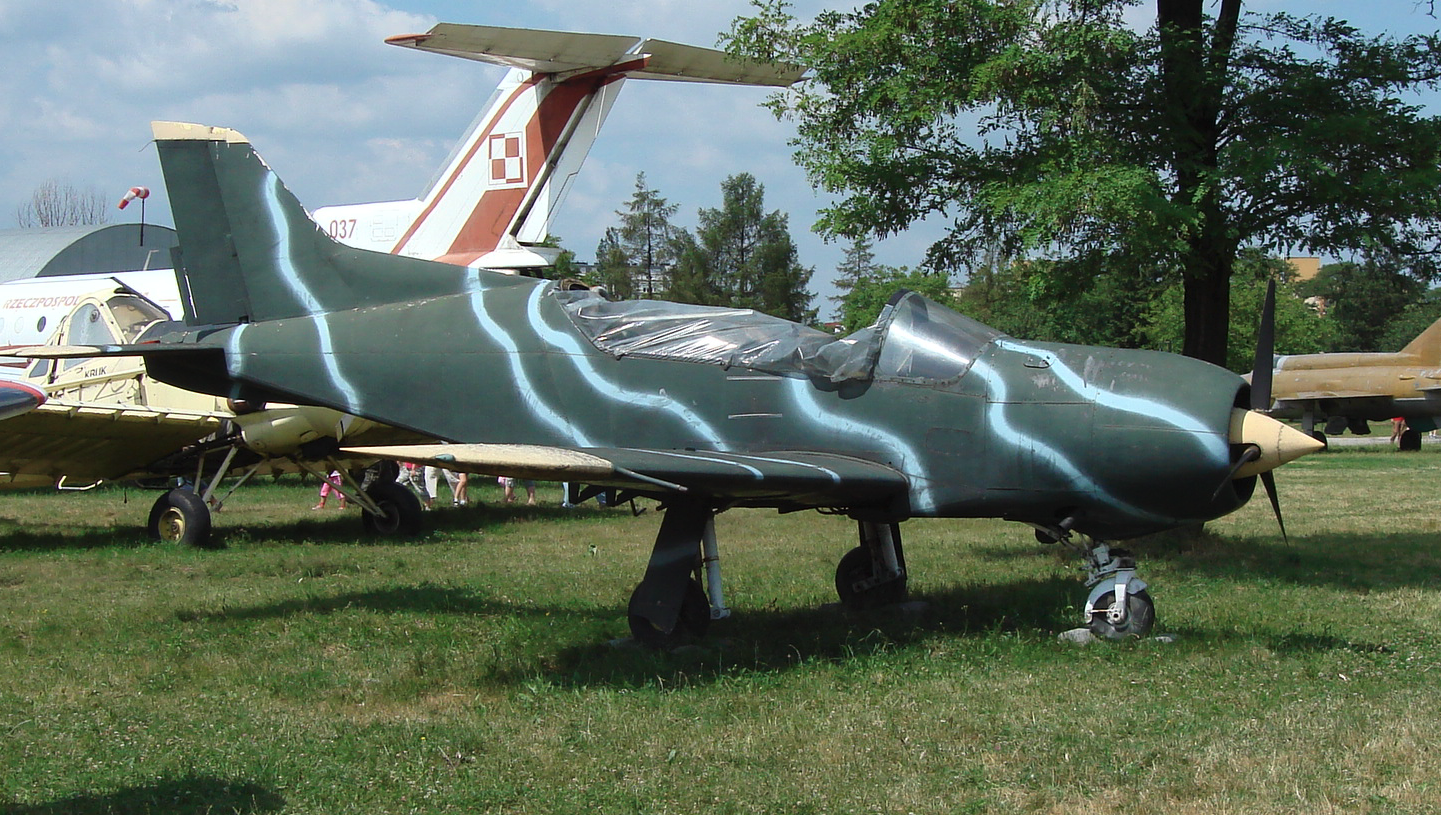
PZL-130 Orlik, piston engine. Design. 2008.
271c Section 1984-10-12
Krakow, September 5, 2008
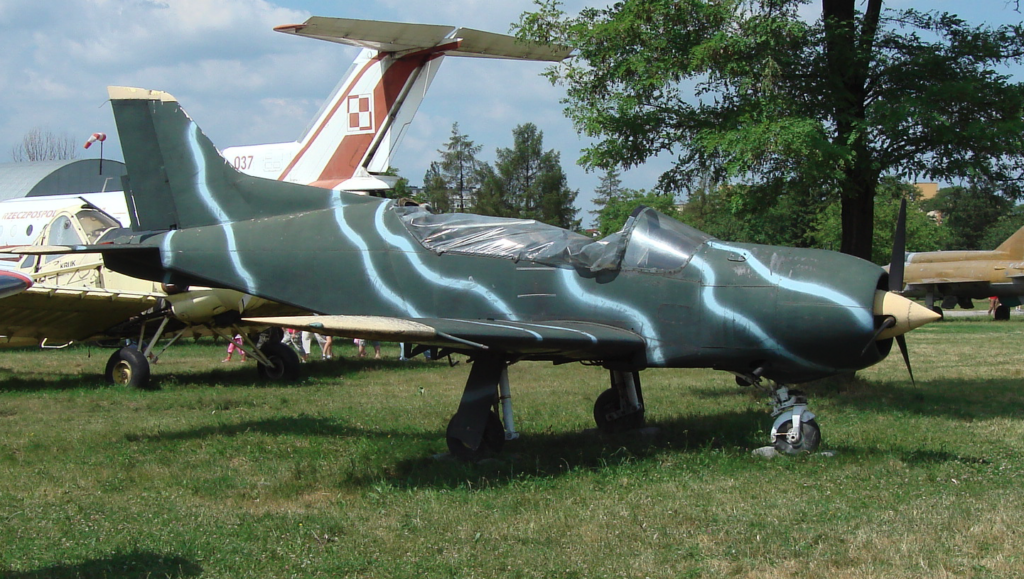
PZL-130 Design
Single-engine, two-seat low-wing trainer aircraft of metal construction. Piston engine.
NACA 642215 wing profile modified for constant aileron and flap chord. Lift +5 degrees, fuselage wing angle 0 degrees, geometric twist 3 degrees. The structure is a single-section, box-shaped, multi-spar metal structure with a riveted box and welded trailing edge. Frise-type ailerons deflect 20 degrees up and 12 degrees down. Slotted flaps deflect 10 degrees for takeoff and 40 degrees for landing. The wingtips are made of glass-epoxy composite.
Fuel: Flat bottom, elliptically vaulted top. Semi-monocoque metal structure, riveted from welded components. The cabin glazing is made of Plexiglas bonded to glass-epoxy composite frames. The canopy opens to the right side. The canopy can be jettisoned in an emergency. To facilitate boarding, a fixed footrest attached to the fuselage allows passengers to stand on the left wing. The cabin accommodates two passengers in a tandem configuration. The rear seat has a slight headroom. The seats are electrically adjustable and are adapted for the use of both back and seat parachutes.
The tailplane is conventional, with a clearly defined horizontal tail advance. The metal structure is partially welded. The rudder deflects 30 degrees to both sides. The horizontal tailplane span is 3.50 m.
The landing gear is a tri-leg undercarriage with a nose wheel, retractable in flight. All wheels are single. The nose landing gear is telescopic with a half-fork wheel and lateral vibration damper. The main landing gear wheels are on wishbones with hydraulic disc brakes. Oil-gas shock absorbers. Low-pressure tubeless tires. Parking brake. The landing gear base is 2.22 m long. The main landing gear wheelbase is 3.10 m long.
Controls: Pushrod ailerons with a torsion tube on the starboard side of the fuselage. The elevator is operated by a pushrod-cable system. The rudder is cable-operated. The flaps, trim tabs, and engine cooling air intake shutters are electrically operated. The power unit is controlled by double-acting flexible rods (arens). The control lever sectors.
The instrument panel includes a magnetic compass, airspeed indicator, altimeter, artificial horizon, gyrocompass, turn indicator with inclinometer, variometer, clock, manifold gauge, and an engine management indicator that displays fuel pressure, oil pressure, and oil temperature. Other instruments include a tachometer, cylinder head temperature gauge, carburetor thermometer, two fuel gauges, carburetor thermometer, stall indicator, accelerometer, malfunction indicator system, flap position indicator, landing gear position indicator, signaling device, main air pressure gauge, emergency air pressure gauge, and brake pressure gauge.
PZL-130 Powerplant
9-cylinder radial engine, Vedeneyev M-14 Pm type, 243 kW. Air starting. Three-blade adjustable metal propeller. The propeller diameter is 1.95 m. The PZL-Kalisz K-8 AA engine, a modernized version of the M-14 Pm engine, was to be used.
PZL-130 Systems
Fuel: Four integral tanks in the wing box, each with a capacity of 2 x 100 liters and 2 x 110 liters. A 9-liter service tank is located in the fuselage.
Pneumatic: The pneumatic system is dual-circuit, with a primary and emergency circuit. Operating pressure: 4.9 MPa.
Electric: 24/28 V electrical system. 3 kW generator. 24 V/18 Ah battery.
Hydraulic system. Equipped with a 26-liter oil tank and a radiator with thermostat.
Avionics.
The aircraft is equipped with a set of flight and navigation instruments and engine control. A set of system control instruments. A fault indication system. A UHF radio, radio compass, intercom, rocket launcher, fire extinguisher, and first aid kit are also available. The aircraft can be fitted with a radio altimeter. Armament.
The aircraft is equipped with two light weapons slings located under the wings. These can be unguided missile pods or various types of light bombs.
T-T PZL-130 data. Year 1984.
Span 8.00 m. Length 8.45 m. Height 4.00 m. Wing area 12.28 m². Wing aspect ratio 5.21 m. Empty weight 950–1,110 kg. Gross weight 1,500 kg. Maximum weight 1,600 kg. Payload 250 kg. Fuel weight 420 kg. Wing load 130.1 kg/m². Engine power-to-weight ratio 6.04. Maximum speed 340-380 km/h. Climb rate 7.0-7.4 m/s. Landing speed 116 km/h. Cruising speed 316 km/h. Maximum range 1,415-1,460 km. Ceiling 4,200-7,000 m. Takeoff run 300 m. Landing distance 240 m. M-14 Pm engine with 243 kW.
T-T data PZL-130. Year 1986.
Wingspan 9.00 m. Length 8.45 m. Height 4.00 m. Wing area 12.80 m2. Wing aspect ratio 6.33. Empty weight 1,112-1,147 kg. Gross weight 1,520 kg. Maximum weight 1,600 kg. Payload weight 300 kg. Fuel weight 420 kg. Wing loading 125 kg/m2. Engine power to weight ratio 6.04. Maximum speed 340 km/h. Climb rate 7.1 m/s. Landing speed 115 km/h. Cruise speed 310 km/h. Maximum range 1,430 km. Ceiling 4,300 m. Take-off run 300 m. Landing roll 240 m. 243 kW M-14 Pm engine.
Written by Karol Placha Hetman