
Kraków 2008-09-05
271c Section 1984-10-12
PZL-130 Orlik. Poland. Tally.
000 – mockup. It was built in full size in 1982. The mockup received multi-colored (yellow, brown, and blue) camouflage and the fictitious nb 0252.
001 – non-flight prototype. Designated for fatigue testing.
002 – first flight prototype. Registration SP-PCA. First flight on October 12, 1984, piloted by Witold Łukomski. The aircraft is practically unpainted. It was left in the color of natural duralumin sheets with anti-corrosion protection, giving it the appearance of having been painted in various shades of light yellow. Registration black. Orange rudder, indicating it is a prototype.
003 – second flight prototype. Registration SP-PCB. The first flight was made on January 14, 1985, as the third Orlik aircraft. The aircraft was painted in camouflage known as “Chinese.” The entire aircraft was painted dark green with blue-gray veins. The airframe tips were yellow. In 1985, the aircraft was shown at a military equipment exhibition in Beijing. After a series of tests, it was transferred to the museum in Czyżyny in 1990.
004 – the third flying prototype. Registration SP-PCC. First flown on December 29, 1984, as the second Orlik aircraft. The aircraft was painted navy blue throughout. The registration was white. The rudder was orange, indicating it was a prototype. The wingtips and horizontal tail were also orange, which later became a distinguishing feature of production aircraft. In 1985, the aircraft was shown at the Paris Air and Space Salon. The aircraft was selected for conversion from piston to turboprop power. The engine selected was a Pratt-Whitney PT 6A-25 A producing 410 kW (550 hp), with a three-blade Hartzell HC-B3TN-3B/T10173K-11R propeller. It has three variable-pitch blades. In November 1985, the aircraft was shipped by sea to Canada. The components needed for the conversion were manufactured in Poland and shipped by sea to Canada. These included an engine mount, engine cowlings, hydraulic system actuators, and others. The aircraft received a new paint job. The conversion was completed in mid-1986. The aircraft, named Turbo Orlik (PZL-130 T / TP), made its first flight on July 13, 1986, other sources say July 16, 1986, with test pilot Jerzy Wojnar, MSc. Eng. at the controls. The aircraft fully lived up to the hopes placed in it. The Turbo Orlik’s promotion began with Colombia, which intended to mock 80 (!) aircraft of this class. Unfortunately, during the show on January 20, 1987, due to pilot error, the plane crashed, killing Bogdan Wolski, who had previously conducted Turbo Orlik tests, and a Colombian air force officer.
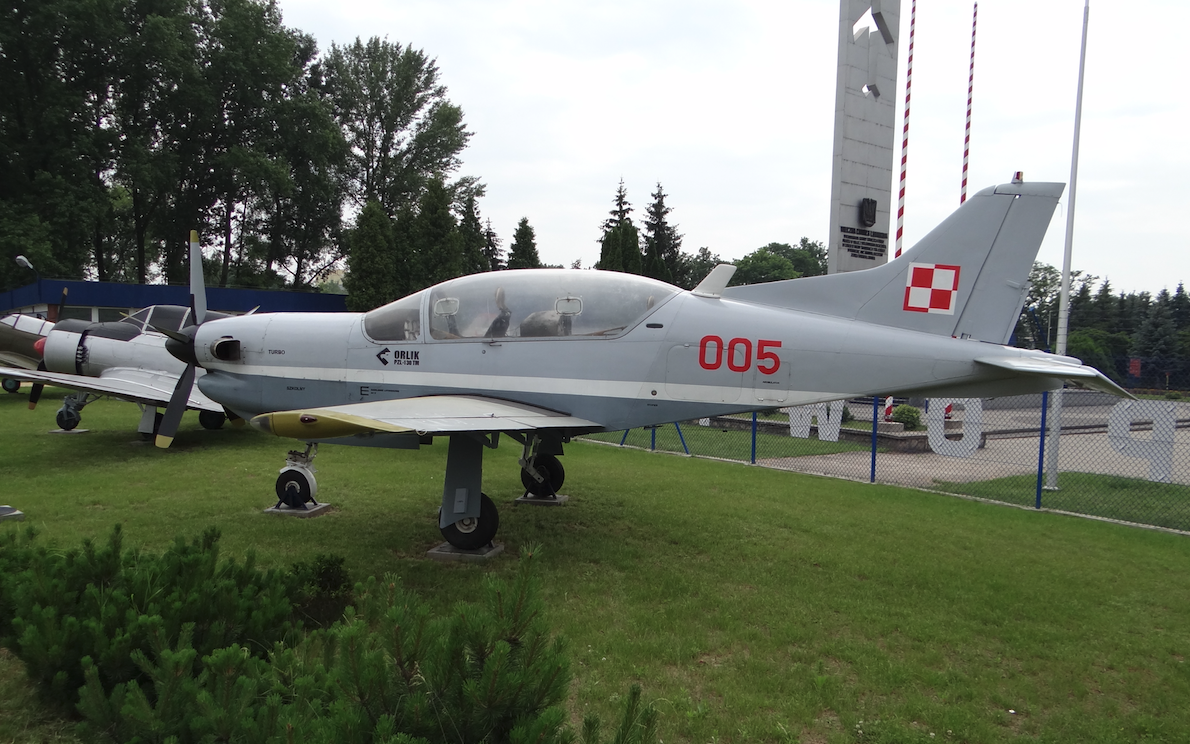
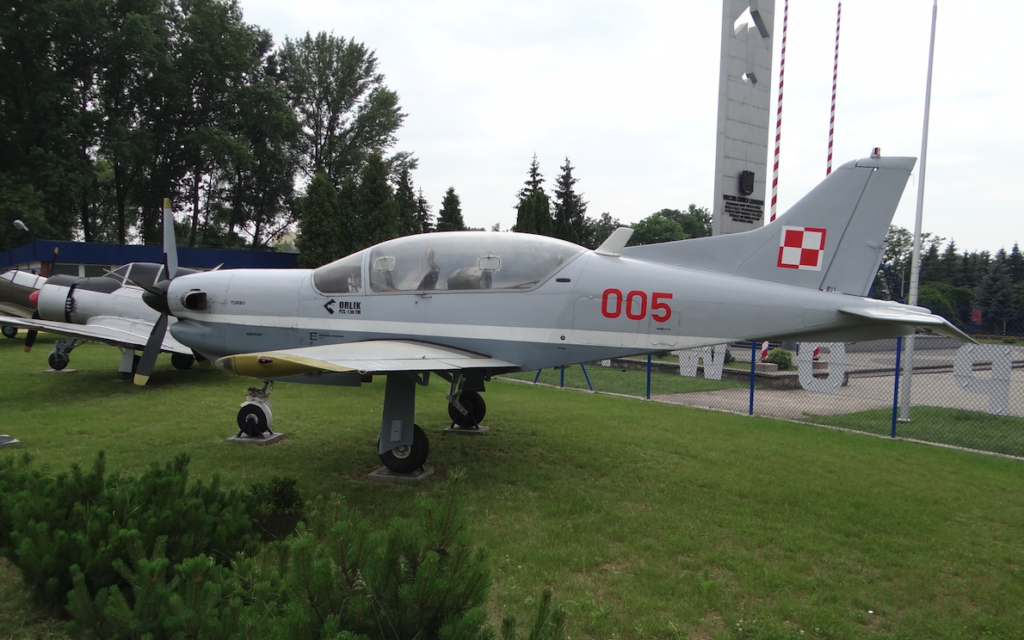
005 – pre-series. In the second half of the 1980s, the Polish Army ordered a short series of PZL-130 Orliks with piston engines and an option for a total of 25 units. The first PZL-130, No. 005, was equipped with an AI-14 piston engine. It first flew on February 19, 1988. However, after trials, the Ministry of National Defense decided not to accept these aircraft. In 1990, the aircraft was equipped with a Walter turboprop engine. Designation PZL-130 TM. The aircraft were used for liaison flights between the 23rd EL (Air Squadron) in Dęblin and the 45th ELD (Air Experimental Squadron) in Modlin.
006 – pre-series. It belonged to the same series as No. 005. Equipped with a PZL-Kalisz K-8 AA piston engine. The first flight took place on March 19, 1988. Like No. 005, it received a Walter turboprop engine in 1990. The aircraft were used for liaison flights with the 23rd EL (Air Squadron) in Dęblin and the 45th ELD (Air Experimental Squadron) in Modlin.
007 – pre-series. Built from the outset for turboprop power. A Walter M-601 engine with a 550 kW output, coupled with a five-blade Avia VJ8.508E propeller. The first flight was performed on January 12, 1989, piloted by IL test pilot Jan Gawęcki, M.Sc. Eng. After completing numerous tests, the aircraft was transferred to the Air Force Academy in Dęblin as a non-flight teaching aid.
008 – pre-series. The aircraft was designated PZL-130 TC No. 008, registration SP-WCA. The aircraft made its first flight on March 15, 1990, and was followed by a series of tests, including at the 32nd PLRT in Sochaczew. The aircraft was displayed in Israel and South Africa.
009 – pre-series. The aircraft received the designation PZL-130 TB, no. 009, and registration SP-PRF. It was powered by a Walter M-601 T engine with 551 kW (750 hp). It was completed in 1992. The aircraft has a one-meter longer wingspan. The cockpit canopy was enlarged and modified. The tailplanes were modified, along with many other changes in line with the new technical specifications. The first flight took place on September 17, 1991. In this form, the aircraft was approved by the Polish Army and accepted into service with the Air Force and Air Defense as a basic training aircraft. During difficult and dangerous trials on January 25, 1996, the aircraft was destroyed, burying two pilots (?). Further trials were conducted by aircraft no. 037.
010 – pre-prototype. The aircraft received the designation PZL-130 TC No. 010, equipped with a P&W Canada PT6A-62 engine producing 699 kW (950 hp). It is equivalent to aircraft No. 011, but with significantly less sophisticated avionics.
011 – pre-prototype (demonstrator). The aircraft received the registration SP-PCE and was equipped with a P&W Canada PT6A-62 engine producing 699 kW (950 hp) and a four-blade Hartzell HC-D4N-2A propeller. The first flight was performed on June 2, 1993, by J. Wojnar and T. Dunowski. The aircraft was equipped with Bendix-King digital avionics, an integrated data bus, on-board computers, a Flight-Vision HUD, and multi-function displays alongside the traditional flight instruments. Martin-Baker Mk CH15A ejection seats were also fitted. The aircraft was also equipped with light armament suspended from six underwing nodes with PZL-UBP beams. Around 2005, the aircraft was transferred to the Czyżyny Museum without its engine and cowlings.
012 – The first production model of a batch of 9 aircraft (nos. 012 – 020). They were designated PZL-130 TB. The aircraft were painted gray camouflage, with yellow wingtips and propeller spinners, three-digit red side numbers, and checkerboards (old pattern). The aircraft’s first flight took place on August 21, 1992.
013 – The second PLZ-130 TB. This example, with registration SP-PCF, was presented at the Paris Air Show in 1993. In 1994, it was in service with the Polish Army, no longer registered, and with the number 013. Later, it was transferred to the Polish Aviation Museum in Czyżyny.
014 – PZL-130 TB. Later upgraded to PZL-130 TC-I standard.
015 – PZL-130 TB. Later upgraded to PZL-130 TC-I standard.
016 – PZL-130 TB. Later upgraded to PZL-130 TC-I standard.
017 – PZL-130 TB. Later upgraded to PZL-130 TC-I standard.
018 – PZL-130 TB. Later upgraded to PZL-130 TC-I standard. In 1995, tests were conducted on underwing armament. This aircraft was equipped with PZL-UBP booms, allowing for the suspension of machine gun pods, NPRs, bombs, or auxiliary tanks. The adopted standard, however, differed from NATO standards. In 2003, it was shown in Mierzęcice (Pyrzowice).
019 – PZL-130 TB. Later upgraded to PZL-130 TC-I standard. In 2005, it was shown in Pruszcz Gdański.
020 – PZL-130 TB. Later upgraded to PZL-130 TC-I standard.
021 – pre-series PZL-130 TC-I. Another PZL-130 TB aircraft, which received class 0-0 ejection seats, improved avionics, a new checkerboard pattern, reflective orange wingtips and tailplanes, and several other minor changes. Over time, previous PZL-130 TBs were upgraded to PZL-130 TC-I standard. It crashed, but no further details are available.
022 – pre-series PZL-130 TC-I. Identical to No. 021. Treated as the first aircraft of the second series (No. 022 – 027) and transferred to the military in Radom. In 1995, it was displayed in Dęblin. In 2003, it was displayed in Radom.
023 – PZL-130 TC-I. In 2006, it was displayed in an unusual location in Warsaw in front of the Hotel Sobieski.
024 – PZL-130 TC-I. In 1994, it was shown in the press as one of the first PZL-130 TC-Is.
025 – PZL-130 TC-I. In 1999, it was shown in Radom. In 2005, it was shown in Dęblin.
026 – PZL-130 TC-I.
027 – PZL-130 TC-I. A total of 14 aircraft were already in Radom.
028 – PZL-130 TC-I. In 2003, it was shown in Radom.
029 – PZL-130 TC-I.
030 – PZL-130 TC-I.
031 – PZL-130 TC-I.
032 – PZL-130 TC-I.
033 – PZL-130 TC-I.
034 – PZL-130 TC-I. Crashed on October 11, 2001.
035 – PZL-130 TC-I. In 2004, displayed in Pruszcz Gdański.
036 – PZL-130 TC-I. Crashed on May 9, 2001.
037 – PZL-130 TC-I. After the crash of aircraft no. 009 in 1996, it took over further necessary tests. It underwent tests of the suspended tanks. The second one was rebuilt to the PZL-130 TC-II version and first flew in 2007.
038 – PZL-130 TC-I.
039 – PZL-130 TC-I. Crashed on January 5, 2002.
040 – PZL-130 TC-I.
041 – PZL-130 TC-I. Shown in Malbork in 2004.
042 – PZL-130 TC-I.
043 – PZL-130 TC-I.
044 – PZL-130 TC-I. Shown in Radom in 2007.
045 – PZL-130 TC-I.
046 – PZL-130 TC-I. Shown in Malbork in 2004.
047 – PZL-130 TC-I. The first to be converted to the PZL-130 TC-II version. First flight on October 8, 2003.
048 – PZL-130 TC-I.
049 – PZL-130 TC-I.
050 – PZL-130 TC-I. In 2004, it was shown in Malbork.
051 – PZL-130 TC-I. One of the last production PZL-130 Orliks. In 2005, it was shown in Radom. On August 30, 2008, it was shown in Mińsk Mazowiecki at the 23rd Blot.
052 – PZL-130 TC-I. The last production model.
PZL-130 Orlik aircraft versions:
PZL-130 – prototypes with the M-14Pm engine (PZL K8-AA).
PZL-130 T/TP – prototype with the PT6A-25A/25C engine and simple Western avionics.
PZL-130 TB – production aircraft for the Polish Armed Forces (Walter M601T) – converted to the TC-I.
PZL-130 TC – export version (PT6A-62) with extensive avionics equipment.
PZL-130 TC-I – production version for the Polish Army (M 601T).
PZL-130 TC-II – production version for the Polish Air Force (PT6A-25C).
PZL-130 TC-III – a design for a version with glass-cockpit avionics (PT6A-25C), initially designated TC-II.
PZL-130 TD – a design for a version with a PT6A-25C engine and simple Western equipment.
PZL-130 TE – a design for a version with a PT6A-25A engine and simple Western equipment.
PZL-130 TM – a designation for the Polish Air Force (M-14Pm/M 601E).
PZL-130 H – a design for a Hungarian Air Force aircraft (M 601T).
Written by Karol Placha Hetman