
Kraków 2026-11-09
Before we discuss the R66 helicopter, we will describe the helicopters that preceded this design.


Robinson R22.
The Robinson R22 light helicopter was developed in the United States in 1973 by engineer Frank D. Robinson. The concept was to create an affordable, lightweight helicopter accessible to everyone. To achieve this, it was powered by a Textron Lycoming O-320-B2C piston engine, producing 160 hp (118 kW). The helicopter features a cabin designed for two people: a pilot and a passenger.
The Robinson R22 made its maiden flight on August 28, 1975. It received certification from the Federal Aviation Administration (FAA) in March 1979. Serial production began in April 1979, and by 2015, more than 4,600 units had been manufactured by the Robinson Helicopter Company. The Robinson R22 remained in serial production as late as 2019. These helicopters are frequently purchased by American farmers for monitoring herds of cattle.
Due to its relatively low purchase and operating costs, the R22 is popular worldwide, primarily as a trainer aircraft. It is also well-suited for reconnaissance, the inspection of power lines and pipelines, and liaison flights.
The main rotor consists of two blades. The rotor system is controlled via mechanical linkages, without the use of hydraulic assistance. This control system is highly sensitive, but pilots who have mastered the R22 are well-prepared for training on larger helicopters. The rotor has significant inertia, and a separate friction brake—with its control handle located on the cabin ceiling—is used to bring it to a stop.
The basic airframe structure consists of welded chrome-molybdenum steel tubing. The forward fuselage is constructed from fiberglass and aluminum, with Plexiglas windows. The tail boom, as well as the vertical and horizontal stabilizers, are made of aluminum. The R22 features an enclosed cabin with side-by-side seating for a pilot and a passenger.
The helicopter is equipped with a skid-type landing gear; there is no wheeled landing gear option. A ground-handling dolly is used to move the helicopter on the ground. A version equipped with floats is also available.
The R22 utilizes a unique “T-bar” cyclic control stick. The main control column extends from a central console rather than from the floor between the pilot’s legs. The control stick is accessible from either the left or right seat. If the person in the other seat is not a qualified pilot, the control grip on that side can be removed. This design facilitates entry and exit for both pilots and passengers. The R22 is equipped with a voice-activated intercom; earlier models featured a floor-mounted, foot-operated switch.
Lycoming engine.
The helicopter is powered by a Lycoming O-320 or O-360 engine—a 4-cylinder, air-cooled (via a fan), carbureted engine. It is mounted in a horizontal orientation and runs on 100LL aviation gasoline. Newer engine variants incorporate an automatic rotor speed governor. The engine is naturally aspirated (not turbocharged). Power from the engine is transmitted to the drive system via drive belts. Initially, four separate V-belts were used; however, based on operational experience, this was changed to two dual V-belts. A belt-tensioning actuator is employed, which also serves to disengage the engine from the drive shaft. During startup, the engine is engaged while the belts are slack, allowing it to run without turning the rotor system. A one-way sprag clutch is integrated into the center of the upper pulley, enabling the rotor system to continue rotating in the event of an engine failure—allowing the R22 to enter autorotation and perform a controlled landing.
Robinson R22 specifications:
Length 28 ft 8 in (8.74 m). Height 8 ft 11 in (2.72 m). Main rotor diameter 25 ft 2 in (7.67 m). Tail rotor diameter 3 ft 6 in (1.1 m). Empty weight 880 lb (399 kg). Gross weight 1,370 lb (621 kg). Maximum speed 190 km/h. Service ceiling 14,000 ft (4,300 m). Maximum range 209 nmi (241 mi, 387 km). Fuel capacity 16.9 US gal (14 imp gal; 64 l).
Robinson R44.
The success of the Robinson R22 helicopter led the Robinson Helicopter Company to develop a larger, four-seat model. The R44 made its maiden flight on March 31, 1990, and received FAA certification in December 1992. Serial production began in 1993. Since 1999, the R44 has been the world’s best-selling general aviation (GA) helicopter. Between 2001 and 2020, a total of 5,941 R44 units were manufactured.
The R44 is powered by a 183 kW, 6-cylinder, horizontally opposed Lycoming IO-540-AE1A5 engine.
The design of the R44 is based on that of the R22. Notably, the direction of rotation of the tail rotor was changed compared to the R22 to improve yaw control.
Several modifications were introduced throughout the production run. In July 2002, the Robinson Raven II variant was launched, featuring a more advanced fuel-injected engine and wider rotor blades, which allow for an increased gross weight and higher service ceiling.
The Robinson Helicopter Company also developed the R66, which is powered by a turbine engine and can carry five people.
Design of the Robinson R44.
The Robinson R44 is a four-seat light helicopter produced by the Robinson Helicopter Company since 1993. Based on the company’s two-seat Robinson R22. The R44 helicopter is equipped with hydraulic flight control assistance. The R44 helicopter is a single-engine helicopter with a semi-rigid two-blade main rotor, two-blade tail rotor and skid landing gear. The machine has a closed cabin with two rows of seats next to each other for the pilot and three passengers. In July 2002, Robinson unveiled the R44 Raven II, featuring a more powerful fuel-injected engine and wider blades, allowing for a higher gross weight and better performance at altitude.
T-T Robinson R44 data:
Main rotor diameter 33 ft (10 m). Length 38 ft 3 in (11.66 m). Height 10 ft 9 in (3.28 m). Tail rotor diameter 3 ft 6 in (1.1 m). Curb weight 1,505 lb (683 kg). Takeoff weight 2,500 lb (1,134 kg). Maximum speed 130 kn (150 mph, 240 km/h). Cruising speed 109 kn (125 mph, 202 km/h). Practical ceiling 14,000 ft (4,300 m). Maximum range 300 nmi (350 mi, 560 km). Fuel supply 31.6 US gal (26 imp gal; 120 l). Fuel 100 octane low lead (100LL) fuel or 100/130 octane. Fuel consumption 15 gallons per hour (12 imp gal/h; 57 l/h. Lycoming IO-540-AE1A5 6-cylinder air-cooled horizontally-opposed piston engine, 245 hp (183 kW).
Robinson R44 in Poland.
On July 9, 2018, the Air Force Academy in Dęblin signed a contract with JB Investments for the purchase of two R44 helicopters for the academic school center. Both purchased machines were delivered to Dęblin on November 14, 2018.
On July 31, 2018, Robinson R44 helicopters were also selected by the Air Rescue Service in a tender for the supply of two training helicopters.
The Border Guard has received its first R44 helicopter.
On April 11, 2019, the Border Guard took delivery of an R44 helicopter. The aircraft is used for purposes including the training of flight personnel, as well as for the primary task of monitoring state borders. Discussions regarding the acquisition of a new helicopter for the Border Guard began as early as mid-2018. The Ministry of the Interior and Administration issued a tender for a multi-role helicopter with at least four seats, intended for use by the Border Guard’s aviation unit for operational flights (patrol and reconnaissance) and administrative transport over land territory. The cost for one R44 helicopter was 3,175,000 PLN. The tender process concluded on November 16, 2018.
The Robinson R44 Raven II helicopter acquired by the Border Guard features modern digital avionics (a “glass cockpit”), dual controls, and a four-seat cabin. It is powered by a six-cylinder Lycoming IO-540-AE1A5 engine with a takeoff power of 245 hp, enabling a speed of 234 km/h and a range of approximately 560 km—a distance that can be extended using auxiliary fuel tanks, which can be installed beneath the passenger seats.
On Thursday, April 11, 2019, Deputy Prime Minister Beata Szydło and Minister of the Interior and Administration Joachim Brudziński officially handed over the first R44 helicopter to the Border Guard. The new aircraft was blessed by the Border Guard chaplain. The event took place at the air base located at 188 Węgierska Street in Nowy Sącz. In 2019, the Border Guard added an Airbus Helicopters H135 helicopter—valued at over 46 million PLN—to its fleet, and in 2020, the service acquired two Let Aircraft Industries L 410 UVP E-20 aircraft.
Robinson R66.
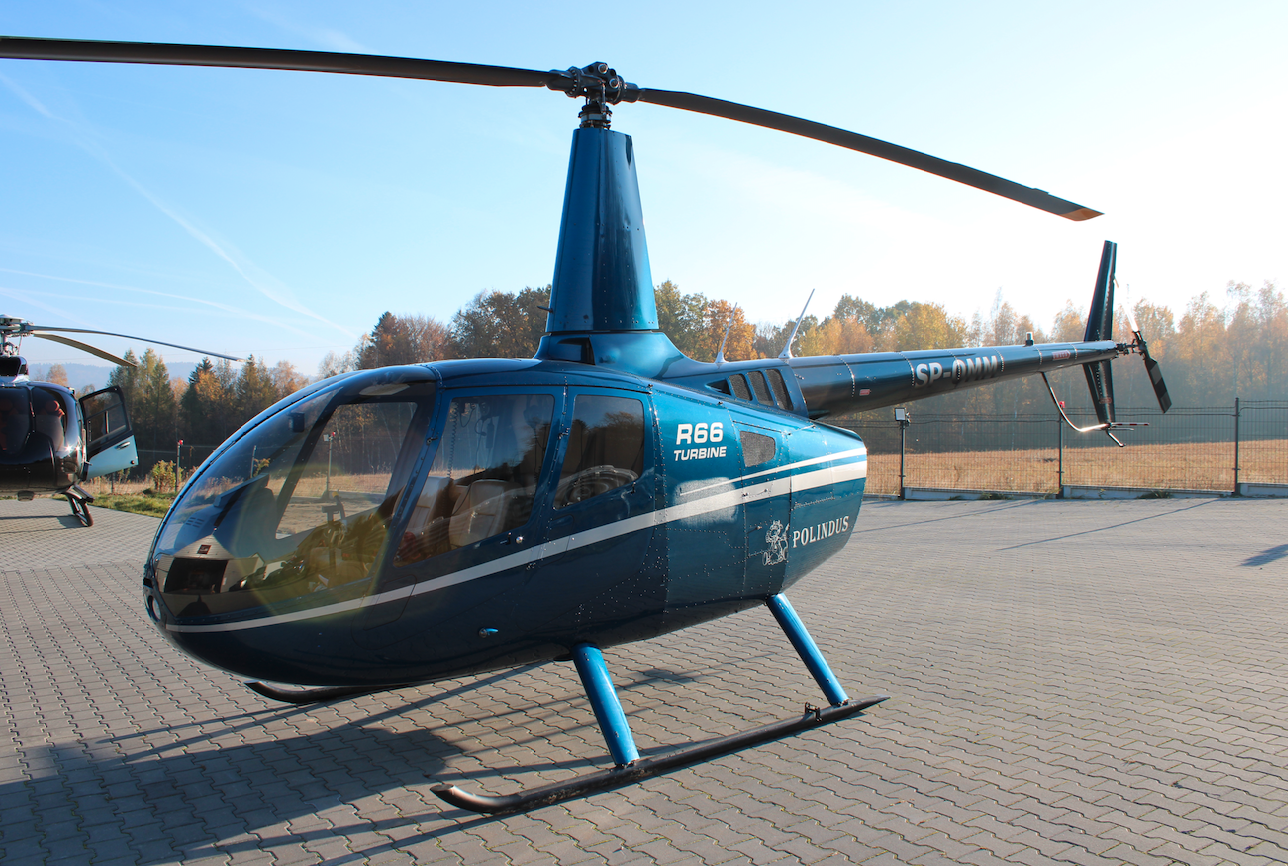
The Robinson R66 is a light helicopter designed and manufactured by the Robinson Helicopter Company. It features five seats, arranged in a configuration similar to that of a passenger car—though, in reality, the rear bench is quite cramped. It is powered by a Rolls-Royce RR300 turboshaft engine. The R66 is slightly faster and offers a smoother flight than the piston-engine Robinson R44 model, upon which it is based. On October 25, 2010, the R66 received both its type certificate and production certificate from the U.S. Federal Aviation Administration (FAA).
The R66 was announced by the company in 2007, at which time initial optional orders were collected. The primary design change was the incorporation of a turbine engine; the company aimed to expand its market reach to include operators with better access to jet fuel, positioning the helicopter as a complementary addition to an operator’s existing fleet. The design of the R66 is largely based on the earlier, piston-powered R44 model.
Robinson began accepting orders for the R66 in February 2010, with production commencing that same year. By 2011, the aircraft had entered full-scale production. A four-seat version, equipped with specialized gear—including cameras (such as thermal-imaging units), loudspeakers, and searchlights—was developed for police use. By 2012, 191 R66 helicopters had been delivered. During the same period, competitors delivered a total of only 40 single-engine helicopters. Approximately 70 percent of R66 helicopters are exported outside the United States. Production reached up to 4 helicopters per week, with over 100 units built annually. However, the production rate subsequently fell to two units per week. In 2015, the production rate increased to 3 helicopters per week.
The company entered into negotiations with the engine manufacturer, Rolls-Royce, regarding the RR300 engine. As a result, a 10-year contract was signed for the supply of 100 engines per year.
The R66 helicopter received certification in several other countries: Canada in June 2013, the European Union (EASA) in April 2014, China (CAAC) in May 2014, and Russia in March 2013. By December 2015, the company had delivered its 700th R66 helicopter. In January 2017, the company announced that it had reached a milestone of 12,000 total aircraft delivered, with the 12,000th unit being an R66 model.
In 2014, the R66 Turbine Marine variant was developed, featuring inflatable floats that allow for water landings; these floats cannot be retrofitted onto a standard R66 helicopter. In 2015, a version equipped with an external cargo hook was developed, and the maximum gross weight was increased from 1,200 kg to 1,300 kg. In 2017, Robinson began offering an optional lithium-iron-phosphate (LiFePO4) battery, the TB17. Weighing 16 pounds (7.3 kg), this battery is lighter than the previously used options—namely, the standard battery (weighing 42 pounds / 19 kg) and the high-capacity version (weighing 52 pounds / 24 kg). In 2024, the 1,500th R66 helicopter was built. The Robinson R66 is the first helicopter from Robinson to feature a small baggage compartment, capable of carrying a load of up to 300 pounds (140 kg). The helicopter is turbine-powered; the turbine engine is lighter than the Lycoming O-540 piston engine used in the R44 model, resulting in a lower empty weight for the R66. The RR300 turbine engine utilizes a simplified, single-stage centrifugal compressor, which helps reduce its purchase price. Furthermore, a centrifugal compressor is more resistant to surge and offers more stable operating characteristics. The temperature within the combustion chamber is approximately 600 degrees Celsius. Naturally, the turbine runs on Jet-A fuel. Depending on operating conditions, the engine consumes about 23 US gallons (87 liters) per hour. For comparison, the R44, equipped with the O-540 engine, consumes 15 US gallons (57 liters) of avgas per hour.
In 2001, Robinson redesigned the tail section and introduced a symmetrical horizontal stabilizer. This was intended to eliminate the risk of a main rotor blade striking the tail boom. The FAA approved the new empennage design, which was also aimed at improving longitudinal (roll-axis) stability during high-speed flight.
For taxiing the R66 helicopter, wheel holders with handles were installed on the skids to lift the helicopter onto the added wheels. At the front, under the helicopter, there is a small electric tractor powered by a battery. The front of the helicopter is electrically lifted on the tractor’s pin and the tractor wheel is moved electrically. The steering is manual by the helicopter operator. The helicopter is raised approximately 5 cm. There are different types of tow dollies available. There are strollers without a drive that can be pulled, for example, by a quad bike. In theory, it is possible to move an R66 helicopter without an electric tractor, with the help of two people, by pressing down on the helicopter’s tail boom, thereby raising the front of the helicopter.
Robinson R66 technical data. Crew: one pilot and 4 passengers. Load capacity 540 kg. Length 29 ft 6 in (8.99 m). Length: 29 feet 6 inches (8.99 m). Width: 4 ft 10 in (1.47 m). Height: 11 feet 5 inches (3.48 m). Curb weight: 1,290 lb (585 kg). Gross weight: 2,700 lb (1,225 kg). Fuel tank capacity: 73.6 US gal (279 liters). Powerplant: 1 Rolls-Royce RR300 turbo-shaft engine; continuous power 224 HP (167 kW), take-off power 270 HP (200 kW), for 5 minutes. Main rotor diameter: 33 ft (10 m). Tail rotor diameter: 5 feet (1.52 m). Cruising speed: 110 knots (130 mph, 200 km/h). Maximum speed: 140 knots (160 mph, 260 km/h). Range: 350 nautical miles (400 mi, 650 km). Practical ceiling: 14,000 feet (4,300 m). Climb rate: 1,000 ft/min (5.1 m/s). Fuel consumption: 23 US gal (87 liters) per hour.
Robinson R88 is a newly developed design that has not yet been flown (November 2026). The machine has ten seats and is powered by a Safran Arriel 2W turbo-shaft engine. The project was announced in March 2025.
Written by Karol Placha Hetman