
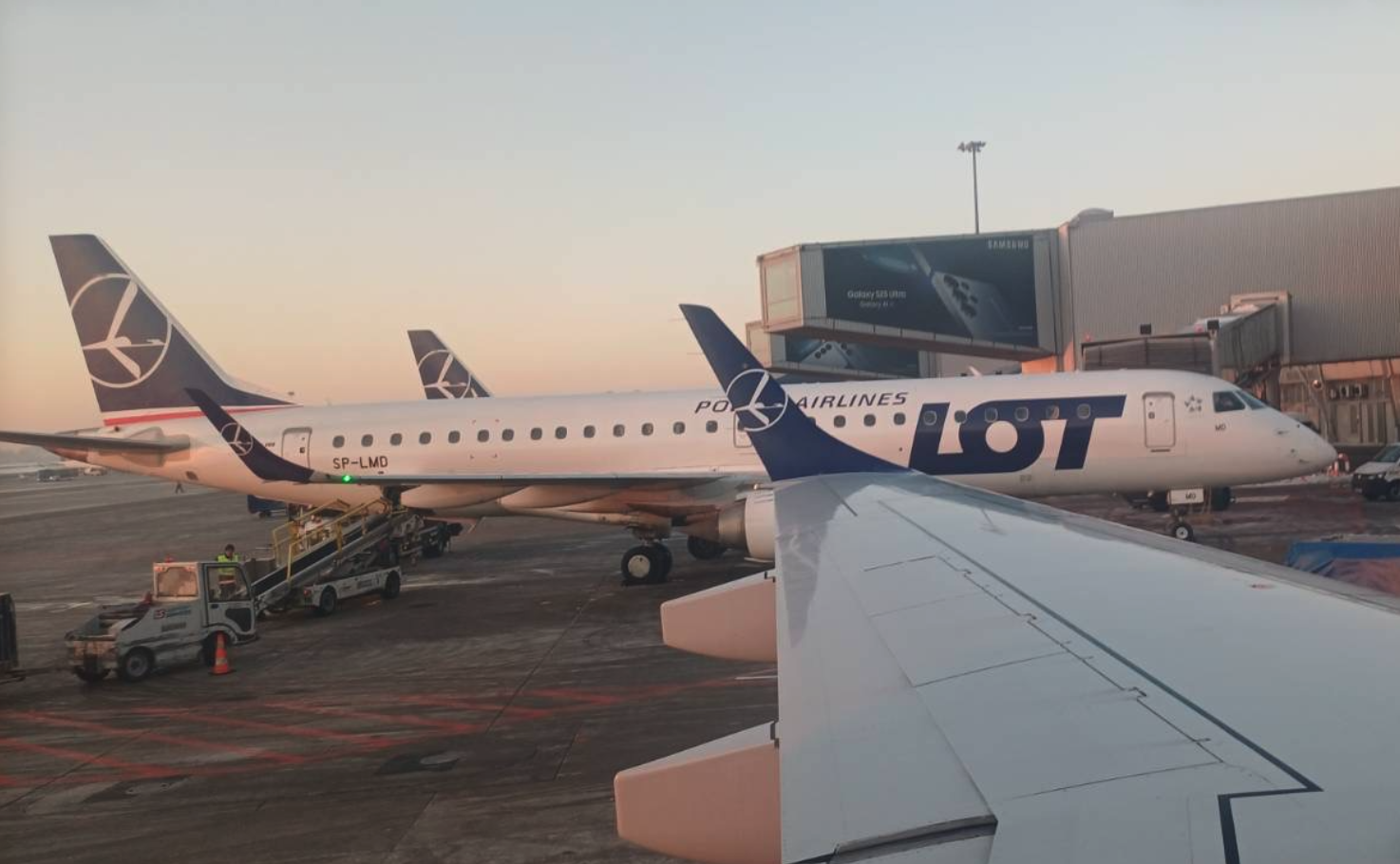
Warszawa 2026-02-04
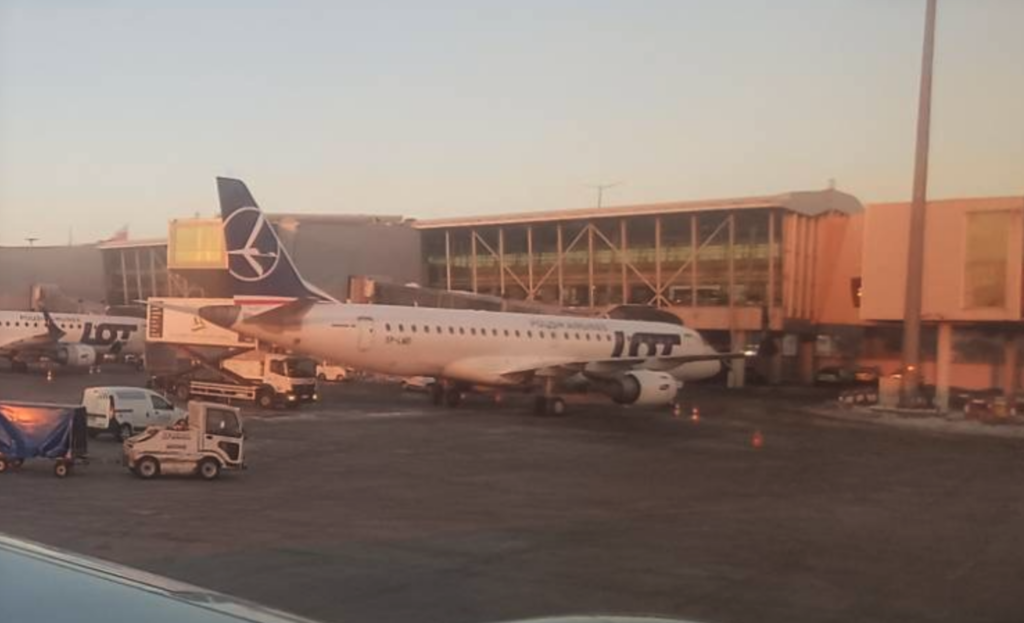
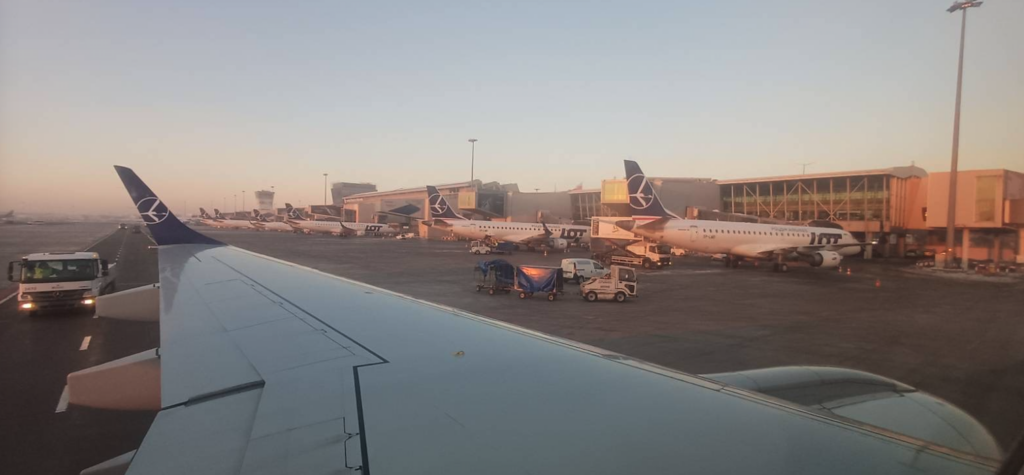
Embraer ERJ E-190 SP-LMD. 2026
The Embraer ERJ E-190 is a commercial aircraft manufactured by the Brazilian company Embraer. A complete family of aircraft has been developed: the E-170, E-175, E-190, and E-195. The E-170 is the first aircraft in the family. The prototype was completed on October 29, 2001. The E-170 made its first flight on February 19, 2002. The first public demonstration took place in May 2002. Two years later, the aircraft received certification. Six prototypes were built.
Embraer.
Brazil is a country perceived in Poland and in the mass media as underdeveloped, with a low level of technological culture. It’s associated only with soccer, coffee, and cotton. But in reality, it’s a powerhouse in the field of aviation technology. Brazil long ago overtook Poland, whose aviation roots are much older. And while in Poland the aviation industry is being systematically phased out, in Brazil it is constantly developing and has increasingly stronger ties with Europe, the USA, and China.
Among the leading aviation companies in Brazil is Embraer. Embraer is one of the largest and most dynamically developing aviation companies in the world. It produces military, business, passenger, and agricultural aircraft. Its products are among the best in terms of cost-effectiveness. Today, Embraer is a company ranked fourth in the world.
The history of the Brazilian aviation industry’s power dates back to the 1940s. In 1950, the Instituto Tecnologico de Aeronautica (Aviation Technical Institute), known as ITA, was established. This institution, which is both a university and an institute (design office), exists to this day. The institute falls under the Brazilian Ministry of Defense and educates civilian and military personnel.
The ITA is currently part of the Aerospace Engineering Agency (CTA), a gigantic military aeronautics and space research center created in 1953, modeled on the American NACA, the predecessor to NASA. The CTA includes the Instituto de Aeronaútica e Espaço (IAE), a research institute developing new aerospace, defense, and space technologies; the Instituto de Estudos Avançados (IEAv), which trains nuclear physicists, among other things; and the Instituto de Fomento e Coodernação Industrial (IFI), which is, among other things, the institution issuing aviation certifications in Brazil. All these institutes are located in São José dos Campos, where Embraer is also currently headquartered.
Work on the first civilian passenger aircraft began in Brazil on March 29, 1965. The aircraft received the designation IPD-6504 and made its maiden flight on October 26, 1968. The aircraft attracted such interest from the Brazilian authorities that on July 29, 1969, the Military Ministry of Aviation established Embraer to produce it. The IPD-6504 was named Bandeirante, meaning “Pioneer” in Portuguese. Shortly thereafter, the design was given the designation EMB 110, under which it is now widely known worldwide. The aircraft’s chief designer was engineer Oziris Silva, who was also appointed director of Embraer.
The EMB 110 was mass-produced for 21 years in over 30 military and civilian versions. The last aircraft was built in 1990. The aircraft are still in service (2020).
Like any company operating for decades, Embraer has had its ups and downs. The most serious crisis was the 1990-1994 period. The company’s sales in 1990 fell from $700 million to $177 million. Brazil was in the grip of an economic crisis and high inflation. Employment was cut by over 50 percent. Despite this, losses still amounted to $200 million. The decision was made to privatize the company.
During privatization, the Brazilian government provided significant support to the company. It was committed to maintaining the country’s aviation industry. It took complete control of spending and began seeking strategic investors. The government also pledged that federal agencies would purchase from Embraer. The company itself was exempt from customs duties and additional fees on imported materials essential to the aviation industry. Taxes on domestically produced materials, raw materials, and equipment were also reduced. Brazilian corporations could invest their 1% of their income tax in Embraer bonds. During privatization, the Brazilian government assumed $700 million of the company’s debt and recapitalized another $350 million. Customs exemptions were granted. The company was required to maintain its workforce for six months. The management board was also ordered to remain unchanged. In December 1994, privatization was completed. But government support did not end. Embraer continued to receive preferential loans. Similar terms were granted to companies cooperating in the aviation industry. Embraer has regained financial liquidity. It’s worth remembering that the US government is supporting Boeing as best it can, and interested European governments are supporting Airbus.
Embraer decided to take a risk and focus its efforts on the ERJ 145, a design developed since 1989, because the management saw a niche in turbojet passenger aircraft with 40-110 seats. Boeing and Airbus found these designs unprofitable. Bombardier was the sole manufacturer. A total of $300 million was spent on the ERJ 145 program. The design was a great success. In 2010, Embraer began targeting designs with up to 200 seats. Embraer’s most well-known designs include: The AMX (Italian-Brazilian combat aircraft), the EMB 312 Tucano (trainer, approximately 650 built since 1983), the EMB 202 Ipanema (agricultural aircraft powered by alcohol), the ERJ 145, ERJ 170, ERJ 190, and several others. The Embraer C-390 Millennium transport aircraft has been a major success.
Embraer’s main facilities are located in São José dos Campos. Military aircraft are built in Eugenio de Melo. Business jets are built in Gaviao Peixoto. Agricultural aircraft are built in Botucatu. The company has offices in France, the USA, Singapore, and China. Gaviao Peixoto is home to the longest RWY in Brazil and the fourth longest in the world. Its length is 4,967 m. Due to its parameters, it was considered as an emergency landing site for space shuttles.
Throughout its history, Embraer employed nearly 22,000 people at its peak. In 2012, the company employed approximately 17,000 people, an excellent result. 65% of its employees have a secondary education, 29% have university degrees, 4% have postgraduate degrees, and 2% are doctoral candidates. The high technical education of its employees is one of the foundations of the company’s success.
City of São José dos Campos.
São José dos Campos is a city in southeastern Brazil, in the state of São Paulo, on the Paraíba River. The city’s name translates as “Saint Joseph of the Fields.” It is one of the most important industrial and research centers in South America. São Paulo is 80 km from the capital, and Rio de Janeiro is 320 km away. According to a 1999 UN study, the city ranked first among 25 Brazilian cities in terms of quality of life. It is considered very safe and offers a wealth of shops and services. The city’s population is 640,000. Nearly 10,000 people have been growing annually. The city is a former and current industrial center. Its industries are primarily cotton and coffee.
Embraer commercial aircraft.
In 2010, journalists were impressed by the company’s achievements. They wrote that Brazilian Embraer was conquering the world with its aircraft, with a capacity of up to 130 passengers. They wrote that the company was a business phenomenon. But Embraer’s successes date back several decades. The company has always been, and continues to be, supported by the Brazilian government. Together, they are seeking markets. They are observing other manufacturers and asking for potential users. They fear competition and therefore constantly monitor the market. Due to the crisis in the early 1990s, they undertook a massive reorganization, with significant government support. A government that, unlike in Poland, did not abandon the company to its own devices but sought out investors. Market analysis indicated that the ERJ 145 program, launched in 1989, should be continued, focusing on the development of a commercial aircraft. A potential customer, Continental Express, was also identified.
Further commercial aircraft.
The thriving ERJ 145 program motivated the company to take on an even greater challenge. In 1999, at the Paris Air Show, work on a new family of commercial aircraft, with a capacity of 70 to 120 passengers, was officially announced. The decision was made at that time that it would be a family of aircraft, not a single design, similar to Boeing’s 737 family and the Airbus 320 family. It was then revealed that the aircraft would enter production in 2002, indicating that the company was already well advanced in the program.
Ultimately, two commercial aircraft within a single family were developed: the smaller E-170/175 and the larger E-190/195. The E-170/175 aircraft share 95% of their components. However, the E-170/175 and E-190/195 aircraft share 89% of their components. The differences between the two groups are limited to different engines, larger wings, a larger horizontal tail, and reinforced landing gear. All aircraft share the same common denominator: an identical fuselage (with differences only in the additional segments), identical flight decks, identical systems, and Honeywell Primus avionics.
The Brazilians realized they couldn’t produce the highly advanced avionics themselves. They sought the best suppliers abroad. They chose Honeywell Primus avionics with EPIC EFIS (glass cockpit information system) technology. Honeywell and its Aviation Business division offer a full range of products and services for operators of business and regional aircraft. Honeywell Primus EPIC is an integrated avionics system that provides advanced cabin functionality and improves crew situational awareness. The interface is provided by large, flat-panel LCD screens with intuitive operation (Integrated Navigation) and unique, patented graphics (GFP), which allow for quick route modifications. All with weather, terrain, and air traffic monitoring. The displays are highly scalable, allowing charts, maps, and electronic engine instrumentation images to be resized to almost any size and can be viewed in 2D and 3D. Furthermore, the system is designed to enable easy integration of aircraft components and fly-by-wire technology, while also reducing overall weight, wiring, and power consumption. Because the Primus Epic system’s functions are software-based, it can be updated, for example, due to the introduction of new navigation regulations or changes in airspace management.
A few words about the Embraer 170.
The aircraft’s aerodynamic design and the selected powerplant proved to be an ideal solution. The aircraft’s classic layout and proportions, comparable to other aircraft in the E-170 family, proved exceptionally well-received by passengers. Upon boarding, passengers don’t feel like they’re boarding a half-baked aircraft. Many passengers in Europe believe that E-170 aircraft are manufactured in the USA.
A few words about the powerplant. E-170 family aircraft are considered regional aircraft, commonly powered by two turboprop engines. Embraer took a different approach. They used turbofan engines. Why? After all, turboprop engines consume less fuel and are therefore more economical. But is that really the case? This was the case until the early 1990s. Since 2012, no major manufacturer in the Free World has developed commercial aircraft with turboprop power. Why? The only benefit of a turboprop engine is lower fuel consumption, nothing more. Such an aircraft flies slower, and passengers want to reach their destination quickly. The aircraft takes longer to climb to cruising altitudes, which usually don’t exceed 7,500 meters. At this altitude, there’s a greater likelihood of encountering unfavorable weather conditions, which will extend the flight time. These low and medium altitudes also require avoiding airport zones, where the aircraft will not land. Such an aircraft is exposed to more frequent contact with other airspace users (sports aircraft, private aircraft, helicopters, gliders, and military aircraft). Finally, there’s the issue of the turboprop engine itself. The drive consists of an engine, gearbox, and propeller. In a turbofan engine, there’s only the engine, which is completely enclosed. As a result, the turboprop assembly is more expensive to repair and maintain due to the larger number of components. Due to the propellers, the turboprop engine must be elevated, and then access is only possible from walkways. The turbofan engine is mounted low, making access easier. Constantly improving safety regulations do not favor propeller propulsion. Military aviation history shows that propellers cause significantly more injuries and deaths during aircraft maintenance than turbojet aircraft. Aircraft service technicians on E-2 aircraft (the only aircraft with propellers on US aircraft carriers) even called them mixers. And with good reason.
The progress in turbofan engines is enormous, primarily due to modern materials. These engines are not only quieter and consume less fuel, but above all, they have very long overhaul intervals. Aircraft equipped with such engines, like the elevator, can reach cruising altitudes, often exceeding 12,000 meters. Weather conditions here are usually more favorable. Traffic density is lower. These advantages were long recognized by businessmen from the US and Japan, who demanded high flight altitudes and short flight times for their aircraft. In short, turboprop engines are a thing of the past in commercial aviation.
The term “regional aircraft” is slowly disappearing from the aviation lexicon. Nowadays, passengers want to travel nonstop. The idea of hubs has not caught on. The E-170 family aircraft have a range exceeding 4,000 km, allowing flights of up to 1,500 km, unloading and loading, and returning without refueling. This can significantly reduce fuel costs in foreign markets. On November 6, 2008, Jet Blue’s E-190 completed a non-stop flight from Anchorage, Alaska (Ted Stevens Anchorage International Airport) to Buffalo, New York (Buffalo Niagara International Airport), a total of 2,694 miles (4,989 km). This set a distance record for the E-170 family. The aircraft was empty of passengers and freight, and the flight was non-commercial. The aircraft returned to JFK after two months of charter service.
The E-170/175 family competes with the Bombardier CRJ-700 and Bombardier CRJ-900 aircraft. The E-190/195 aircraft are comparable in capacity to the Boeing 737-100/200 and McDonnell Douglas DC-9 aircraft. However, the cabin layout is different. Embraer designers implemented a 2 x 2 seat layout, reminiscent of short-haul aircraft. It’s worth recalling research conducted by airlines. It showed that, in a 3×3 seating configuration, seats B and E were the least popular with passengers. However, the E-170 didn’t feature a 3×3 configuration due to its small fuselage diameter. As a result, the Brazilians can confidently emphasize in their advertising materials not so much the lack of a middle seat, but rather their lack of competition from Boeing and Airbus.
A key consideration in the design of the passenger cabin was the E-170’s full stand-up height, which prevents head-on collisions with the ceiling. This makes moving along the cabin and taking your seat very comfortable, giving you the feeling of being in a large aircraft.
The E-170, formerly the EMB 170-100, is the first aircraft in the family. The prototype was completed on October 29, 2001. The first flight took place on February 19, 2002. The first public demonstration took place in May 2002. Two years later, the aircraft received certification. Six prototypes were built. The first customer for the E-170 aircraft was LOT Polish Airlines, which took delivery of the first aircraft in March 2004.
The first Polish Embraer 170 ST had the registration SP-LGA. The aircraft was nearing completion when it was demonstrated to LOT Polish Airlines management. The aircraft did not yet have engines, a center wing, or doors. The aircraft already had the registration SP-LGA. At that time, this registration was held by an Embraer ERJ 145 operated by LOT Polish Airlines from 1999 to 2004. In reality, the Embraer 170 was assigned the registration SP-LDA. This was purely a marketing ploy. The Brazilians repeatedly emphasized that LOT Polish Airlines was the first operator of the Embraer 170, which meant exports to Europe, which was crucial for their company. It should also be noted that the SP-LGA registration was held by LOT Polish Airlines Tu-134 No. 8350602 from 1968 to 1982.
The largest operators: Republika Airlines (48 units), Transfer from America (28 units), Saudi Arabian Airlines (15 units), Egypt Air Express (12 units), LOT Polish Airlines, and Alitalia Express (6 units). The E-170 aircraft continued to be developed. In 2012, it was offered in STD, LR, and AR versions. The latter has a higher payload capacity.
The E-175, formerly the EMB 170-200, was developed with less hesitation. After positive feedback from the aviation community about the E-170, the company moved on to developing a longer version, designated the E-175. Two prototypes were built. The E-175 made its first flight in June 2003. The first E-175 was delivered to Air Canada and entered service in July 2005. Customers: Large orders for 54 aircraft for Republic Airlines, which controls Frontier Airlines and Midwest Airlines, and 36 aircraft for Compass Airlines (formerly a subsidiary of Delta Air). Flybe, a British airline, ordered 35 Embraer 175s with options for an additional 60 and purchase rights for 40 more. Data as of 2010.
E-190, formerly EMB 190-100. The E-190 received a lengthened fuselage, larger wings, a larger horizontal tail, and new GE CF34-10E engines with 2 x 82.30 kN (2 x 18,500 lb) of thrust. These aircraft competed with the Bombardier CRJ-1000, Boeing 717-200, and Airbus A318 aircraft. The E-190’s maiden flight took place on March 12, 2004 (registration PP-XMA). Jet Blue was the first to order 100 aircraft with options for another 100. The E-190 is certified for takeoffs and landings at London City Airport, which has a short runway and a steep descent. LOT Polish Airlines’ E-190 aircraft have 106 seats. There are two classes of travel; LOT Business Class offers 9 seats in double seats at the front of the aircraft. Currently (2026), LOT Polish Airlines operates 8 E-190 aircraft.
The E-195, formerly the EMB 190-200, first flew on December 7, 2004. The aircraft received certification in June 2006. The first aircraft to be ordered were British low-cost airline Flybe, which purchased 14 aircraft with options for 12 more. By July 2011, orders had been placed for 349 E-190/195 aircraft. The largest users were Air Canada with 45 aircraft, with options for 60 more, JetBlue Airways with 47 aircraft (104 aircraft in total), Copa Airlines with 26 aircraft, and KLM with approximately 20 aircraft.
The Embraer Lineage 1000 is a variant of the E-190 business jet. Design-wise, it’s a copy of the E-190, but with an extended range of 4,200 nautical miles (7,778.4 km). The cabin is equipped with 19 luxurious passenger seats. The aircraft received certification from the US Federal Aviation Administration on January 7, 2009. The first two aircraft were delivered to the operator in December 2008.
The E-195 X was a shelved project. It was intended to seat 130 passengers, suggesting it was a response to American Airlines, which intended to replace its MD-80s in the near future. However, after analysis, Embraer concluded that the E-195 X would be too short a range. The program was suspended in May 2010.
The Embraer E-Jet E2 is a new family of aircraft, developed since 2016, replacing the Embraer E-170/190 family. Its first flight was on May 23, 2016. This twin-engine aircraft is an incremental development of the original E-Jet family, utilizing the more fuel-efficient Pratt & Whitney PW1900G turbofan engine. The family consists of three variants that share a common fuselage cross-section, differing in length, and are equipped with three different redesigned wings, fly-by-wire controls with new avionics, and an updated cabin. Variants offer a maximum takeoff weight of 44,600 kg to 62,500 kg (98,000 to 138,000 lb) and have a range of 2,000–3,000 nmi (3,700–5,600 km; 2,300–3,500 mi). As of 2026, 199 examples have been built.
T-T Embraer 190 data:
Production since 2004. 451 units built (E-170/175/190/195). Crew: 2. Two GE CF34-10E turbofan engines, 2 x 82.3 kN thrust. Wingspan: 28.72 m. Fuselage length: 36.24 m. Height: 10.57 m. Empty weight: 27,700 kg. Takeoff weight: 47,790 kg (STD version), 50,300 kg (LR version). Fuel capacity: 12,971 kg. Maximum speed: 890 km/h. Cruise speed: 871 km/h. Service ceiling: 12,496 m. Operating ceiling: 12,500 m. Range: 3,336 km (STD version), 4,262 km (LR version). Range with a full complement of passengers: 2,778 km. Maximum takeoff run: 2,300 m. Landing distance: 1,226-1,244 m. Passenger capacity: 98, 106 in the LR version. Fuselage diameter: 3.01 m. LOT Polish Airlines currently operates eight E-190 aircraft.
SP-LMD LOT POLISH AIRLINES EMBRAER ERJ-190-100 STD. The aircraft is over 7 years old. During factory testing, the aircraft had the registration PR-ESV. No. 19000764. Configuration: CY106. The aircraft was delivered to Warsaw on a flight on December 21-22, 2018. The same registration SP-LMD was used by LOT Polish Airlines, a Boeing B-737 36N aircraft, number 28669.
Written by Karol Placha Hetman