
Łask 2026-05-25
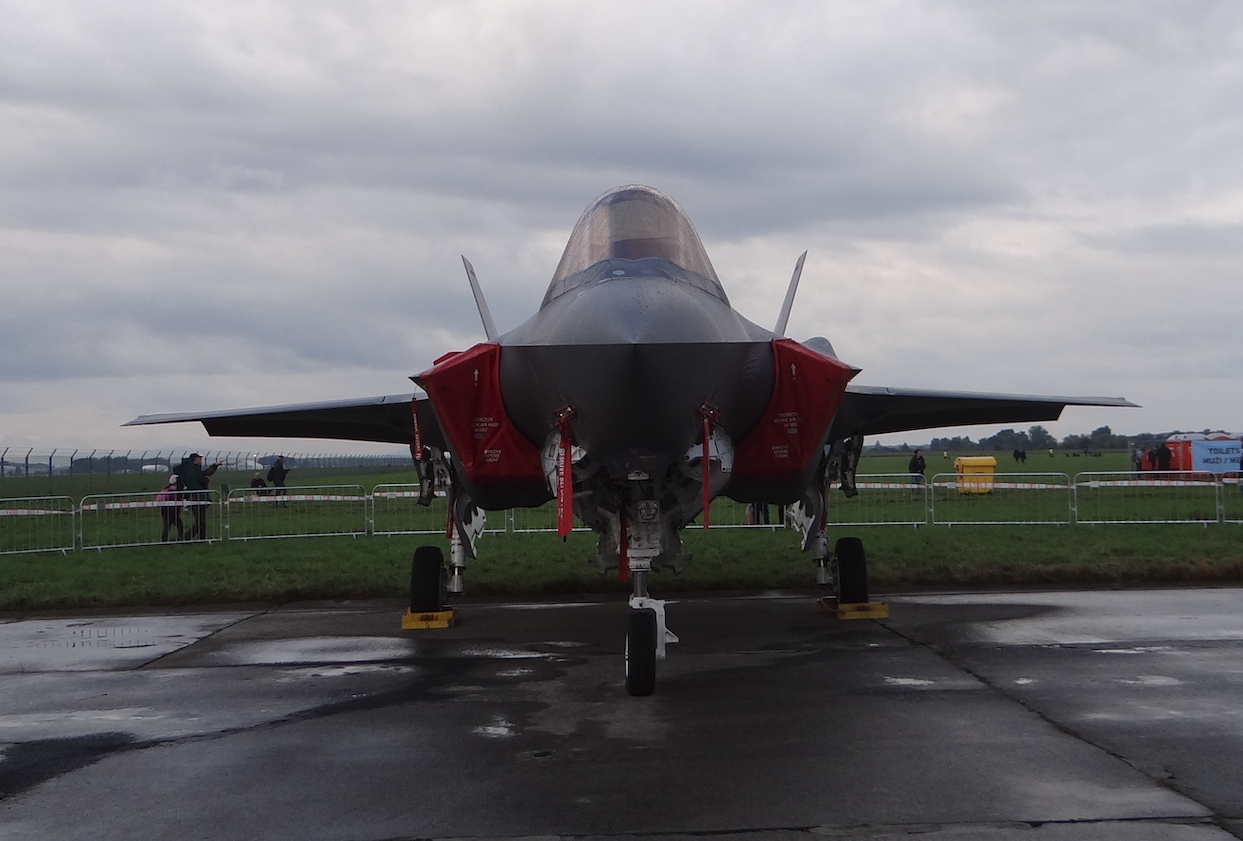
Lockheed Martin F-35A for Poland.
The desire to purchase Lockheed Martin F-35 aircraft was not a whim of the former Polish government, the United Right. It was a consequence of decisions made in 2002, when the purchase of 48 Lockheed Martin F-16 aircraft was decided, one of the conditions being the existence of a successor program. In 2003, it was said that additional F-16 aircraft (not necessarily new) would be purchased within 2-3 years to replace the Sukhoi Su-22s, and even the Mikoyan and Gurevich MiG-29s. However, this did not happen.
In 2015, consideration began to be given to purchasing 64 Lockheed Martin F-35A aircraft for four squadrons. However, the purchase price was unaffordable for Poland due to the country’s poor economic situation. A proposal was made to purchase two aircraft per year. In subsequent years, the plan was to increase this number, with the goal of having a complete set of aircraft by 2030. At that time, the F-35A aircraft cost approximately $95 million. With logistics and spare parts, the price per aircraft was approximately $150 million.
Over the past four years, Poland’s economic situation has improved significantly. This allowed for the realistic commencement of negotiations on the purchase of these aircraft.
On February 28, 2019, the Minister of National Defense, Mariusz Błaszczak, signed a plan for the technical modernization of the Polish Armed Forces by 2026. In it, he announced the expenditure of PLN 185 billion on army modernization. He revealed that the purchase of fifth-generation fighter aircraft under the “Harpia” program would be considered. Only the American F-35 was considered. A plan to purchase 32 Lockheed Martin F-35A aircraft has been revealed. Poland was not interested in the F-35B and F-35C versions, as these are specialized versions for naval aviation and the Marine Corps.
The excellent relations between the Polish Government and the Polish President with the US Administration allowed for the potential acquisition of the aircraft by the end of 2024. Poland is not among the countries that invested in the JSF program and will acquire the aircraft through the Foreign Military Sales (FMS) process. In May 2019, Poland submitted a request for the purchase of F-35A Lightning II combat aircraft.
On September 11, 2019, the US Department of State approved the sale of 32 F-35A aircraft to Poland (in a transaction that could cost up to $6.5 billion, or approximately PLN 25.8 billion). This information was provided by the Pentagon’s Defense Security Cooperation Agency (DSCA).
On September 26, 2019, the US Congress approved the sale of 32 F-35A aircraft to Poland. The announcement was made by Minister of National Defense Mariusz Błaszczak on Twitter and during a press conference.
Concrete Polish-US negotiations have now begun regarding the procurement method, financing, and other issues. The preliminary delivery schedule indicated that Poland could receive the first four F-35A aircraft in 2024, and the aircraft for the entire first squadron (16) would be delivered by 2026.
If the transaction is finalized, its implementation will be overseen by representatives of the U.S. Department of Defense under the Foreign Military Sales (FMS) program. In the past, Poland has purchased, among other products, the Patriot air defense system under this program.
In September 2019, the list price of a single F-35 fighter (excluding weapons and technical assistance) was approximately $89.2 million. However, U.S. experts noted that this was the maximum price (in 2019). The transaction value is estimated at $6.5 billion.
In the Polish Army, Lockheed Martin F-35A aircraft will fully replace MiG-29s and Su-22s and will support Lockheed Martin F-16C/D Jastrząb aircraft.
On January 28, 2020, the U.S. Embassy in Poland announced that Poland would purchase 32 F-35A Lightning II Joint Strike Fighter aircraft for $4.6 billion.
Regarding the price, it’s worth noting that it varies from country to country. The price includes not only the aircraft itself, but also armament, technical support equipment, simulators, training, warranty coverage, and many other factors. Comparing raw numbers doesn’t capture the essence of the matter. For example, the Belgians wanted 34 aircraft. The US State Department initially reported a contract value of $6.53 billion, but after negotiations, it rose to $4 billion. However, we don’t know what armament or training package they purchased.
The contract for the F-35A aircraft has been signed.
On January 31, 2020, Minister of National Defense Mariusz Błaszczak signed a contract for the purchase of 32 fifth-generation Lockheed Martin F-35A Lightning II aircraft. The ceremony, held at the 41st Air Training Base in Dęblin, was attended by President Andrzej Duda, Prime Minister Mateusz Morawiecki, and US Ambassador to Poland Georgette Mosbacher. The contract, worth $4.6 billion (approximately PLN 17.8 billion), also includes mission simulators, a spare engine, pilot and maintenance training, and operational support.
The agreement was stated to be offset-free. This, however, means that there will be no need to conclude additional contracts that may not necessarily generate profits for Poland, such as acquiring technologies that cannot be used. Poland’s obvious mistake was not joining the Joint Strike Fighter program in 2003. Poland opted for the purchase without offset, believing that the industrial benefits declared by Lockheed Martin (selected F-16 and C-130 Hercules aircraft maintenance capabilities) would not offset the offset costs, which were expected to exceed $1 billion.
The Polish F-35As will be virtually identical to those used by the USAF. Modifications will be necessary to the airfield infrastructure where these aircraft will be based. This was, of course, to be expected. The Łask Airport, where F-16s are based, was chosen as the base for the F-35s. Purchasing Lockheed Martin F-35As was a very good decision. In 2003, we signed a contract for the purchase of 48 Lockheed Martin F-16 C/D aircraft, and as it turned out, it was a very good decision. Purchasing the F-35s is a continuation of our alignment with the most powerful country in the world. There will always be opponents and they will find hundreds of reasons to question the decisions made. And these are people who do not wish Catholic Poland happiness and secure borders.
Poland will receive its first F-35A in 2024, and the last in 2030. The first aircraft will arrive in Poland in 2026, with trained Polish pilots and technicians. The first full squadron (16 aircraft) will begin flying in Poland in 2026. The Americans are considering possibly starting training in the US using their aircraft, which will accelerate the process. The contract stipulates that 24 pilots and 90 ground crew members will be trained in the US, including those up to instructor level. Additional soldiers will be trained domestically.
What is the F-35 A like?
The F-35 A is a fifth-generation combat aircraft. Years of program development and numerous adjustments made during the research and development period work to its advantage. Moreover, the aircraft has already been used in combat.
Opponents of the aircraft point out that it is the only aircraft without a head-up display (HUD). However, the aircraft is equipped with a helmet-mounted display. This means that when the pilot looks down, he can see what’s below the aircraft, not the floor. Therefore, it is the first combat aircraft where visibility from the cockpit is marginal. The cockpit glazing consists of a single window, reinforced with a single arch.
The F-35A can utilize unprepared field landing strips, a capability recognized as early as the 1990s.
The F-35A is equipped with a fixed 25mm cannon, larger than the 20mm Vulcan-class cannons previously used by the USAF. The F-35A’s armament consists of a GAU-12/U 25mm cannon mounted internally in the F-35A’s fuselage, with a supply of 180 rounds.
The F-35A’s missile armament consists of up to six AIM-120 AMRAAM, AIM-9X Sidewinder, or AIM-132 ASRAAM missiles in internal ammunition bays, or two air-to-air missiles and two 910kg bombs each. The F-35A can carry both powered and glide bombs. At the cost of losing stealth, weapons can be suspended from four under-wing and wingtip mounts (for AIM-9 missiles). The payload increases to 8,165 kg.
The F-35 aircraft generally lacks a drogue parachute, but Norway has one installed in its aircraft to facilitate landings on icy runways.
The basic F-35A also lacks an in-flight refueling probe, but Canada does have one in its aircraft. The aircraft generally refuels through a connector located on the aircraft’s dorsal fuselage.
The F-35 is a command center. The aircraft is distinguished by its interoperability, including compatibility with the Patriot system, which we acquired in 2018. It also works with F-16 aircraft, which we have had for over a decade.
The F-35 is manufactured in four locations: the tail section at BAE Systems in Samlesbury, Lancashire, England; the center fuselage at Lockheed Martin in Marietta, Georgia; the nose section with air intakes is manufactured by Northrop Grumman in Palmdale, California; and Lockheed Martin in Fort Worth, Texas, produces the cockpit and wing sections and is responsible for final assembly. The F-35 program is still under development. The Block 4 variant is being developed, which some believe is delayed, and others believe is being deliberately slowed down. This is due to the fact that currently (2026) the F-35 has no competitor. The F-35 is not an ordinary aircraft. It is a combat platform that combines the roles of a fighter, reconnaissance aircraft, strike aircraft, and electronic warfare center in one. As its manufacturer, Lockheed Martin, emphasizes, the F-35 processes sensor data faster than any previous NATO design, and the pilot sees the battlefield in a way that was considered science fiction just a decade ago. The aircraft is equipped with a four-barrel, 25 mm Gatling gun, GAU-22/A. The F-35 is powered by the most powerful fifth-generation engine currently available in the world. However, the aircraft only reaches a speed of Mach 1.6 (approximately 1,960 km/h) at high altitude. This isn’t an impressive performance, but it is a compromise resulting from the adopted aerodynamic design. Cruising speed is Mach 0.85. The Polish aviation industry is integrated into the global supply chain for this aircraft. Advanced components and spare parts for the F-35 engines are manufactured at, among other locations, Pratt & Whitney’s facilities in Rzeszów.
On May 22, 2026, the first three F-35s arrived in Poland. The aircraft appeared over Łask, over the 32nd Tactical Air Base, accompanied by two F-16s, forming a “staircase” formation. This day is significant in the history of Polish Aviation. For safety reasons and to comply with the American manufacturer’s requirements, the aircraft did not feature red-and-white checkerboards. The aircraft are painted with gray checkerboards, not red-and-white. It should be noted that the checkerboards on the F-16s were also obscured. The first Polish F-35s arrived in Europe from a base in Texas within 48 hours. Along the way, the aircraft stopped, among other places, in the Azores.
During the arrival, Paweł Szefernaker, the President’s Chief of Staff, was present at the Łask airport. Colonel Krzysztof Duda, Commander of the 32nd Tactical Air Base in Łask, was present.
The Łask base was modernized between 2023 and 2025. The modernization cost was approximately 900 million złoty.
It should be emphasized that the current government (2026)—Volksdeutsche, communists, and Freemasons—did not succeed in destroying the contract. Moreover, they claim credit for the success of acquiring the F-35 aircraft. Let us remember: the father of the F-35 acquisition program is Mr. Mariusz Błaszczak, former Minister of National Defense, and for that we thank him. Poland has joined the elite club of countries possessing a fifth-generation fighter aircraft, a platform that is transforming operations in the air, cyberspace, and the entire defense system. For the Polish Air Force, this is the greatest technological leap since joining NATO.
As of May 22, 2026, Poland has received 12 F-35 aircraft. Most of them remain in the United States, at Ebbing Air Force Base in Arkansas, where they are used to train Polish pilots and technicians. This is standard procedure for all new F-35 operators. A similar procedure was followed for the arrival of F-16 aircraft, which were also delivered by air.
The official welcoming ceremony for the new aircraft in the Polish Armed Forces is scheduled for June 12, 2026.
Written by Karol Placha Hetman